




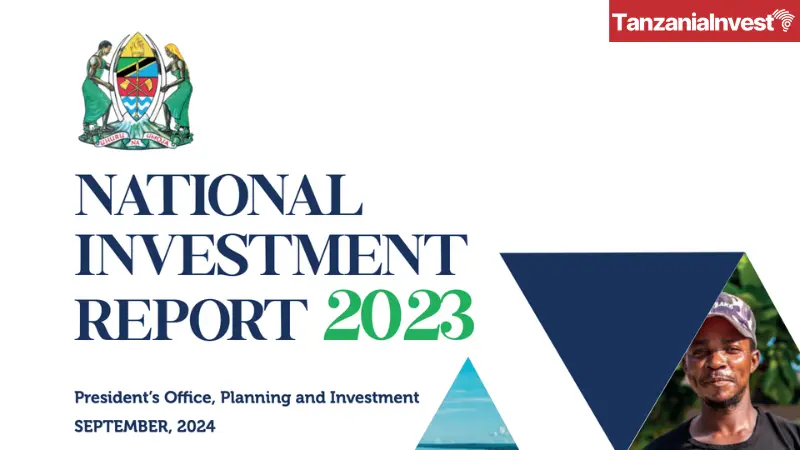
Authored by the President’s Office – Planning and Investment, the Tanzania National Investment Report 2023 provides detailed insights into the country’s economic performance, strategic sectors, investment opportunities and incentives.
The report, released in September 2024 under the leadership of H.E. Dr. Samia Suluhu Hassan, highlights Tanzania’s ongoing efforts to build a vibrant and competitive economy.
With strategic reforms, robust legal frameworks, and extensive opportunities across various sectors, Tanzania invites global investors to explore the vast potential of this dynamic market.

Table of Contents
Introduction
Tanzania, located in the heart of East Africa, stands as a beacon for investors seeking growth, stability, and opportunity. With a rapidly developing infrastructure, robust natural resources, and a favorable business climate, the country is set to attract both Foreign Direct Investment (FDI) and Domestic Investments.
The Tanzania National Investment Report 2023 offers a comprehensive overview of the nation’s investment landscape, highlighting the strategic sectors, government incentives, and the key factors driving economic growth. This summary provides a quick yet detailed insight into the investment opportunities in Tanzania, leading to the download of the full report.
Why Invest in Tanzania?
Under the visionary leadership of H.E. Dr. Samia Suluhu Hassan, Tanzania has made significant strides in creating a conducive environment for investment. The “4Rs” strategy—Reconciliation, Resilience, Reforms, and Rebuilding—has laid the foundation for a modern, vibrant economy that offers numerous opportunities for both domestic and foreign investors.
Summary of Key Sections
1. Introduction
Tanzania’s commitment to becoming a middle-income country by 2025 through sustained economic growth is underscored by reforms that prioritize private-sector participation. The nation is well-positioned to leverage its political stability and abundant natural resources to attract international investments.
2. Overview of Investment Climate
In 2023, Tanzania’s economy grew by 5.1%, a testament to its resilience in the face of global challenges like the COVID-19 pandemic and the Russia-Ukraine conflict. The country’s strategic geographical location, access to major global markets, and strong infrastructure position it as an ideal investment hub in Africa.

3. Key Investment Drivers
Tanzania boasts several investment drivers, including:
- Strategic Location: Tanzania provides access to landlocked countries in East and Southern Africa and is a gateway to the Indian Ocean.
- Natural Resources: Rich in minerals, oil, gas, and arable land, the country presents vast opportunities in agriculture, mining, and energy.
- Young and Skilled Workforce: A large and growing workforce, bolstered by government investment in vocational training.
- Government Commitment: Strong public-private partnerships and investment protection laws.
4. Legal and Institutional Framework
Tanzania’s legal framework, including the Tanzania Investment Act 2022, ensures investor protection with guarantees against expropriation. The country is also a signatory to several international treaties that further protect and encourage investment.
5. Global Investment Trends
Global FDI inflows to Africa are on the rise, with Tanzania positioning itself as a top FDI destination, attracting over $8.6 billion in investment in 2023 alone. This is a 53% increase from the previous year, driven by significant projects in sectors such as energy, manufacturing, and ICT.
6. Investment Performance 2023
Tanzania recorded an increase in registered investment projects, with 9,678 projects valued at $8.6 billion in 2023. Key investors include China, India, and the United States, focusing on infrastructure, technology, and industrial parks.
7. Start-up Ecosystem Development
Tanzania’s start-up ecosystem saw remarkable growth in 2023, with a 25% increase in registered start-ups. Government initiatives, along with private sector support, are fostering innovation, particularly in ICT, agriculture, and renewable energy sectors.
8. Sectoral Investment Opportunities
- Agriculture: Opportunities in cashew nut processing, fruit and vegetable processing, and edible oil production.
- Manufacturing: Investments in textile, apparel, and construction materials.
- Mining and Energy: Tanzania holds significant deposits of gold, diamonds, and natural gas.
- Tourism and ICT: With over 1 million tourists annually, Tanzania’s tourism and ICT sectors are poised for growth.
9. Investment Incentives
The Tanzanian government offers a wide range of incentives, including tax holidays, exemption from import duties, and various fiscal incentives tailored to foreign investors.
10. Notable Investment Projects
Projects such as the Kasulu Sugar Project and Singida Gold Mine represent the large-scale investments shaping Tanzania’s economy. Additionally, industrial parks like Sino-Tan Industrial Park provide essential infrastructure for industrial growth.
Want to know more about the Economy in Tanzania? Our free overview of the Tanzania Business and Investment Guide 2026 covers the Economy, plus key sectors and investment opportunities. The complete 141-page edition includes policies, taxation, key regulations, full macroeconomic data, and sources, and is also available at no cost upon completion of a short form.
Download Free OverviewGet the Full Edition for Free


