


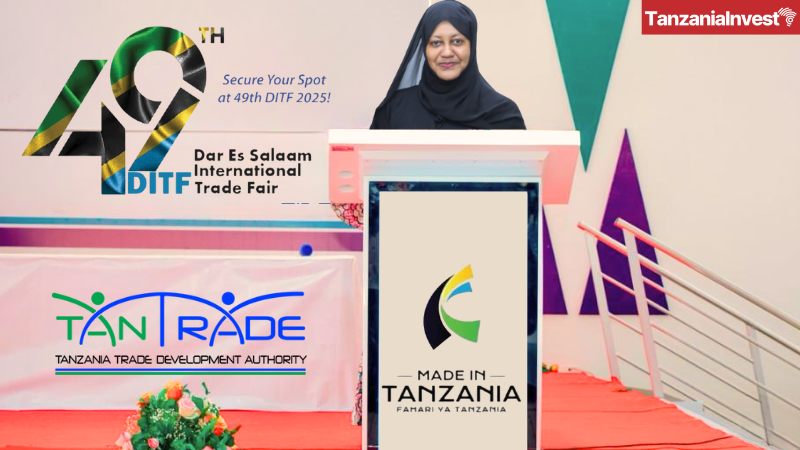
On 7th July 2025, Tanzania officially launched the “Made in Tanzania” brand and Zanzibar Day during the ongoing 49th Dar es Salaam International Trade Fair (DITF) held at the Mwalimu J.K. Nyerere Trade Fair Grounds in Dar es Salaam.
The fair was officially opened by the President of Zanzibar, H.E. Dr. Hussein Ali Mwinyi, in the presence of key stakeholders from both the public and private sectors.
President Mwinyi praised the “Made in Tanzania” brand as a national milestone that would enhance recognition of Tanzanian products in international markets, and urged all relevant institutions to ensure the emblem is adopted widely and serves as a tool for improving quality, visibility, and access for locally made products.

For his part, Tanzania’s Minister of Industry and Trade, Dr. Selemani Jafo, commended the brand launch and the improved investment environment under President Samia Suluhu Hassan, citing growth in electricity generation and infrastructure as critical drivers for industrial competitiveness.
The 49th edition of DITF featured over 5,700 participating companies and introduced major initiatives, including the national emblem for Tanzanian products and a dedicated day to showcase Zanzibar’s trade and investment potential.
The Director General of the Tanzania Trade Development Authority (TanTrade), Latifa Khamis, announced that the exhibition had grown by 10.26% compared to the previous year and was now fully digital under the theme “Saba Saba Digital”.
She highlighted the impact of innovations like the Saba Saba App and the Saba Saba Application Management System (SAMS), which had streamlined exhibitor registration and ticketing.
She also acknowledged East Africa Commercial and Logistics Center (EACLE), the event’s main sponsor for three consecutive years, and introduced Zanzibar Day as a key event aligned with the fair’s mission to promote regional integration and national trade visibility.

On her part, Cathy Wang, General Manager EACLC, reaffirmed the organization’s commitment to enhancing Tanzania-China trade relations.
She announced the completion of EACLC’s 2,000-shop commercial hub in Ubungo, Dar es Salaam, and encouraged Tanzanian enterprises to utilize the new infrastructure for expanding international trade.
On 8th July 2025, DIFT hosted the Zanzibar Day, celebration featured a roundtable highlighting investment opportunities in the Isles with discussions focused on the blue economy, tourism, investment facilitation, and cultural preservation.
Representatives from the Zanzibar Investment Promotion Authority (ZIPA) outlined available incentives, including tax holidays, 100% foreign ownership, and reduced capital thresholds for local investors.
Opportunities were highlighted in aquaculture, heritage tourism, real estate, and manufacturing, especially in value-added marine and agricultural products.
Tourism officials noted Zanzibar’s growing potential in MICE (Meetings, Incentives, Conferences, Exhibitions), health, and marine sports tourism, while calling for more investment in facilities and attractions.
The private sector emphasized the importance of maintaining Zanzibar’s cultural identity and supporting architectural preservation as part of its global tourism positioning.
On the same day, the Deputy Minister for Industry and Trade, Exaud Kigahe, officially launched the national logo for the “Made in Tanzania” brand.
The minister emphasized the importance of the new brand mark in enhancing the visibility, quality, and competitiveness of Tanzanian products and services in both domestic and international markets.
Kigahe noted that the logo represents the collective efforts of the government, private sector, and development partners to promote national production.
He urged all local manufacturers, service providers, government institutions, diplomatic missions, and all stakeholders to adopt the logo as a symbol of authenticity and national pride, stressing that it would help safeguard the identity of Tanzanian goods and improve their global competitiveness.
Kigahe further highlighted that the use of the “Made in Tanzania” logo would increase the value of exports and ensure Tanzanian products are recognized and accepted internationally.
The event included a panel with discussions on the new “Made in Tanzania” brand and its potential to improve international market access. Panelists discussed trade facilitation tools such as the Tanzania Trade Portal and emphasized public-private cooperation in leveraging the new brand for broader economic growth.
Practical insights were shared on sourcing Tanzanian products, highlighting that buyers do not rely solely on samples or packaging labels but conduct direct verification by visiting farmers, observing the processing stages, and overseeing product packaging for export.
The discussion stressed the importance of authenticity and traceability, noting that international consumers must be able to scan a product and trace it back to a specific region or producer in Tanzania.
The 49th DITF, also known as “SabaSaba”, is taking place from June 28 to July 13, 2025. Organized annually by TanTrade, the event serves as a strategic platform for local and international exhibitors to promote products, technologies, and services, and to explore trade and investment opportunities across the East and Southern African region.
Want to know more about Industry in Tanzania? Our free overview of the Tanzania Business and Investment Guide 2026 covers Industry, plus key sectors and investment opportunities. The complete 141-page edition includes policies, taxation, key regulations, full macroeconomic data, and sources, and is also available at no cost upon completion of a short form.
Download Free OverviewGet the Full Edition for Free