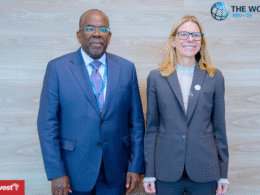


Tanzania’s Ministry of Livestock and Fisheries has tabled a TZS 433.38 billion budget for the 2026/27 financial year, with TZS 335.10 billion (77.3%) directed to development projects including the Kilwa Masoko Fishing Port for offshore fishing in the Indian Ocean Exclusive Economic Zone (EEZ), new fish markets and landing sites, and livestock productivity programmes.
The budget was presented to the National Assembly by Minister of Livestock and Fisheries Dr. Bashiru Ally Kakurwa on 14 May 2026 in Dodoma.
The 2026/27 allocation marks a decrease of about 9.1% from the TZS 476.66 billion approved for 2025/26.

The development envelope is dominated by the Kilwa Masoko Fishing Port in Lindi region, a TZS 280.59 billion project that had reached 97% completion by April 2026 and which is positioned to anchor Tanzania’s offshore fishing and Blue Economy strategy.
Tanzania Livestock and Fisheries Budget 2026/27 Structure
The Ministry has requested Parliament to approve TZS 433,379,125,000 for Vote 99 for the 2026/27 financial year.
Development expenditure accounts for TZS 335,099,705,000 (77.3%), with TZS 193,795,218,000 financed from domestic sources and TZS 141,304,487,000 from external sources.
Recurrent expenditure accounts for TZS 98,279,420,000 (22.7%), of which TZS 49,452,723,000 covers salaries and TZS 48,826,697,000 covers other operational charges.
External financing is drawn from the International Monetary Fund (IMF) Extended Credit Facility (ECF), the Agriculture and Fisheries Development Programme (AFDP), and the second phase of the Agricultural Sector Development Programme (ASDP II), the latter co-financed by the World Bank.

By April 2026, the Ministry had received TZS 186.40 billion of the 2025/26 budget, comprising TZS 66.04 billion in recurrent funding (65.05% of the recurrent allocation) and TZS 120.37 billion in development funding (32.08% of the development allocation), with the low development release rate flagged by the Ministry as a constraint on project execution.
Tanzania Livestock and Fisheries Sector Performance to April 2026
The Livestock sector contributed 6.2% to Gross Domestic Product (GDP) in 2024 and grew by 5.0%, supporting more than 6.5 million livestock-keeping households.
The Fisheries sector contributed 1.6% to GDP in 2024 and grew by 2.3%, supporting around 6 million Tanzanians along the value chain, including 205,559 fishers and 53,992 aquaculture farmers.
Tanzania’s total livestock asset value rose to TZS 34.33 trillion by April 2026, from TZS 33.22 trillion in 2024/25.
Cattle numbers reached 40,569,621 by 2025, goats 29,598,648, sheep 9,944,352, pigs 4,362,829 and chickens 113,361,461.
Meat production reached 1,100,489.85 tonnes in 2025/26, with beef contributing 689,811.46 tonnes, poultry 156,341.21 tonnes, goat and sheep meat 192,552.75 tonnes, and pork 61,784.42 tonnes.
Milk production reached 4,218,529.22 thousand litres in 2025/26, drawn from indigenous cattle (2,826,414.58 thousand litres) and dairy breeds (1,392,114.64 thousand litres).
Fish production reached 490,372.83 tonnes by April 2026, up from 470,353 tonnes in 2024/25.
The Tanzania Fisheries Research Institute (TAFIRI) completed an offshore fish stock assessment in the Indian Ocean Exclusive Economic Zone (EEZ), identifying 10,582 tonnes of commercially exploitable fish stocks for the country’s deep-sea fishing fleet.
The Government collected TZS 460.07 billion from fisheries licence fees, royalties and other charges by April 2026.
Livestock and Fisheries Priorities for 2026/27
The 2026/27 budget supports priorities across animal disease control, livestock productivity, value chain development, Blue Economy infrastructure, aquaculture expansion, fisheries surveillance and research and training.
The priorities are aligned with the Fourth National Five-Year Development Plan 2026/27-2030/31, the National Blue Economy Strategy of 2024, the Livestock Sector Master Plan, the Fisheries Sector Development Programme and the Tanzania Development Vision 2050.
The Ministry has identified deep-sea fishing in the Indian Ocean EEZ, aquaculture expansion across all six water sources (the Indian Ocean, Lake Victoria, Lake Tanganyika, Lake Nyasa, Lake Rukwa and inland water bodies), livestock disease control and the development of the meat, milk and hides and skins value chains as central priorities.
Livestock Sub-Sector Projects 2026/27
Animal disease control and vaccination
The Ministry will continue mass vaccination programmes against East Coast Fever, Foot and Mouth Disease, Contagious Bovine Pleuropneumonia, Newcastle Disease and Rift Valley Fever, with continued procurement and distribution of vaccines through the Tanzania Veterinary Laboratory Agency (TVLA).
Livestock identification and traceability
The Ministry will continue the National Livestock Identification, Registration and Traceability System to improve livestock movement control, disease surveillance and access to export markets.
Livestock genetic improvement
Artificial insemination services and the multiplication of improved breeds will continue through the National Artificial Insemination Centre (NAIC) and the National Ranching Company (NARCO), with NARCO continuing the supply of improved bulls and heifers to farmers.
Slaughterhouse and meat processing infrastructure
The Ministry will continue rehabilitation and upgrading of municipal and export-grade slaughterhouses to meet international meat hygiene standards, alongside support to private investors entering the meat processing industry.
Pasture, feed and rangeland development
The Ministry will continue support for commercial pasture seed production, feed mills and rangeland rehabilitation, with a focus on reducing pastoralist-farmer conflicts through demarcation of grazing areas.
Hides, skins and leather value chain
The Ministry will continue support for the collection, preservation and processing of hides and skins, with the objective of expanding domestic leather manufacturing and reducing exports of raw hides.
Fisheries Sub-Sector Projects 2026/27 (Blue Economy)
Kilwa Masoko Fishing Port
The Kilwa Masoko Fishing Port in Lindi region, valued at TZS 280,585,849,982, had reached 97% completion by April 2026 and continues to receive financing for the final phase.
Completed works include the 315-metre quay (100%), the administration building (98%), the ice production, fish storage, fish processing and fish market building (96%), the water supply station (96%), the electrical substation (97%), the nitrogen gas station (95%), the parking infrastructure (96%), and fuel storage tanks and the ship maintenance workshop (97%), while the fire station stands at 80%.
The port is designed to anchor Tanzania’s offshore deep-sea fishing operations in the Indian Ocean EEZ and to provide cold-chain, processing and export logistics for the fisheries value chain.
New fish markets
The Ministry continues construction of six new fish markets at Tunduma (35%), Kyamkwikwi in Muleba (26%), Masuche in Momba (14%), Manda in Ludewa (40%), Zingibari in Mkinga (65%) and Kasanga in Kalambo (95%), and has completed the Mbamba Bay fish market in Nyasa.
Fish landing sites
The Ministry continues construction of three fish landing sites at Chato Beach in Chato (97%), Kalungu in Nkasi (5%) and Ng’ombo in Nyasa (48%).
Aquaculture centres
The Ministry continues construction of two aquaculture centres at Nyengedi (32%) and Ruvula, with Ruvula’s first phase already completed.
Cold chain and storage
The Ministry will install cold storage facilities with a capacity of 40 tonnes at Pangani and Mchinga, and a fish meal factory at Kilwa Masoko in Lindi region.
EEZ surveillance and deep-sea fishing
The Deep Sea Fishing Authority (DSFA) continues surveillance and licensing of fishing vessels operating in Tanzania’s EEZ, with expanded patrol capacity and the issuance of new licences to qualifying domestic and foreign operators.
Aquaculture inputs
The Ministry will continue to support the supply of 317,642,400 fish fingerlings and 53,813.11 tonnes of fish feed to aquaculture farmers across the country.
Want to know more about Agriculture in Tanzania? Our free overview of the Tanzania Business and Investment Guide 2026 covers Agriculture, plus key sectors and investment opportunities. The complete 141-page edition includes policies, taxation, key regulations, full macroeconomic data, and sources, and is also available at no cost upon completion of a short form.
Download Free OverviewGet the Full Edition for Free