Budget
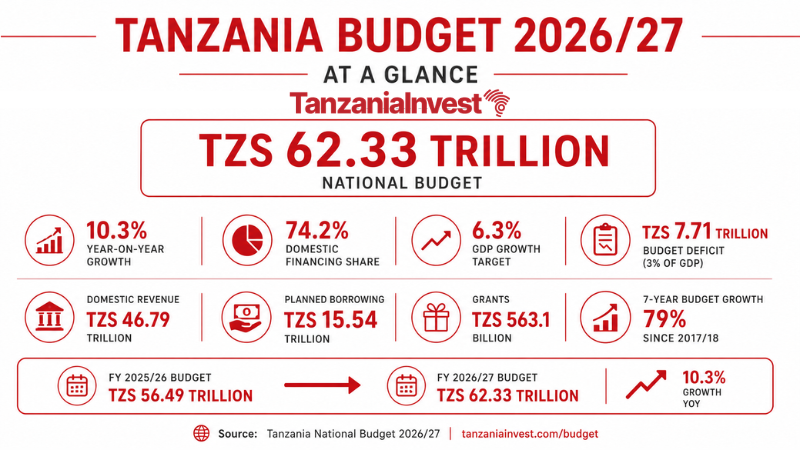 Tanzania's National Budget 2026/27 totals TZS 62.33 trillion (± USD 24 billion), an increase of 10.3% from the TZS 56.49 trillion budget for 2025/26.
Parliament approved the budget on 23 June 2026 by 385 of 393 votes, with the spending plan taking effect on 1 July 2026.
The budget is the first under Tanzania's Fourth Five-Year Development Plan (FYDP IV, 2026/27-2030/31) and aligns with Tanzania Development Vision 2050, which targets a USD 1 trillion economy by 2050.
The figure reflects growth from TZS 34.9 trillion seven years earlier, a 79% increase over the period.
| Indicator | Figure |
|---|---|
| FY 2026/27 Budget | TZS 62.33 trillion |
| FY 2025/26 Budget | TZS 56.49 trillion |
| Year-on-Year Growth | 10.3% |
| Domestic Financing Share | 74.2% |
| Budget Deficit | TZS 7.71 trillion (3% of GDP) |
| GDP Growth Target | 6.3% |
| 7-Year Budget Growth | 79% |
Table of Contents
FY 2026/27 Budget Plan
The FY 2026/27 budget totals TZS 62.33 trillion (± USD 24 billion), presented to Parliament in Dodoma on 11 June 2026 by the Minister for Finance, Ambassador Khamis Mussa Omar.
Total revenue is estimated at TZS 46.79 trillion, comprising tax revenue of TZS 36.99 trillion, other revenue of TZS 9.24 trillion (including Local Government Authority own-source revenue of TZS 1.977 trillion), and grants from Development Partners of TZS 563.1 billion.
Grants fall 39.1% from the prior year, reflecting changes in Development Partner policies.
74.2% of the budget will be financed from domestic revenue, in line with the government's self-reliance objective.
The government plans to borrow TZS 15.54 trillion, comprising domestic loans of TZS 6.56 trillion, external concessional loans of TZS 6.55 trillion, and external commercial loans of TZS 2.43 trillion.
The budget deficit stands at TZS 7.71 trillion, equivalent to 3% of GDP.
FY 2026/27 Expenditure Breakdown
Total expenditure including debt principal repayment equals TZS 62.33 trillion, broken down as follows.
| Category | TZS | Share |
|---|---|---|
| Subsidies and transfers | 25.32 trillion | 40.6% |
| Employee entitlements incl. pensions | 10.13 trillion | 16.3% |
| Debt principal repayment | 7.84 trillion | 12.6% |
| Interest payments | 6.86 trillion | 11.0% |
| Goods and services | 5.22 trillion | 8.4% |
| Other costs | 3.63 trillion | 5.8% |
| Capital investment (non-financial assets) | 2.33 trillion | 3.7% |
| Pension benefits and social transfers | 1.01 trillion | 1.6% |
| Total | 62.33 trillion | 100% |
Combined debt service (interest plus principal repayment) amounts to TZS 14.70 trillion, equivalent to 23.6% of the total budget.
The government has set aside TZS 1.2 trillion (± USD 462 million) specifically to clear arrears owed to contractors and suppliers, with about TZS 100 billion to be disbursed each month.
Strategic Investment Priorities
The 2026/27 budget will expedite strategic investment in industries built on rare earth minerals, natural gas, iron ore, and coal, with an emphasis on domestic value addition.
Railway corridors anchor the investment agenda. The Standard Gauge Railway (SGR) is under construction on the Dodoma-Mwanza and Isaka-Kigoma sections, with the operational Dar es Salaam-Makutupora segment already running. The TAZARA Railway Revitalisation Project is also underway, covering five regions.
Dodoma is being developed as a transport and logistics hub, with the SGR and the new Msalato International Airport as the enabling infrastructure.
A dedicated financing channel is introduced for industrial zones: 5% of designated revenue will be transferred to a special Bank of Tanzania account to fund infrastructure in Export Processing Zones (EPZ) and Special Economic Zones (SEZ), including compensation for acquired land.
Export taxes are imposed on waste paper (30% or TZS 200 per kilogram, whichever is higher) to retain raw material for local manufacturers, and on quartz minerals (10%).
Industrial development levies of 5% to 10% apply to imported steel structures, aluminium structures, and fishing nets to support local production.
The government continues to work with the International Finance Corporation (IFC), Africa50, Africa Finance Corporation (AFC), and the Asian Infrastructure Investment Bank (AIIB) to raise capital, guarantees, and technology for development projects.
Key Tax and Investor Measures for 2026/27
Profit-distribution tax halved: The share of undistributed corporate profits deemed distributed for tax purposes under Section 33A of the Income Tax Act falls from 30% to 15%. The reduction excludes the small financial sector, insurance companies, companies listed on the Dar es Salaam Stock Exchange (DSE), and companies with Framework Agreements with the government.
One-year income tax holiday for new businesses: New businesses under the presumptive tax regime receive an income tax exemption for one year from the date of obtaining a Tax Identification Number (TIN), effective 1 July 2026. After the transition period, normal tax obligations apply.
VAT deferment on imported capital goods: The deferment of Value Added Tax (VAT) on imported capital goods is retained but subject to conditions to be set by the Minister for Finance, modifying the previous automatic deferment.
VAT exemptions on energy and green infrastructure: Full VAT exemptions apply across the Compressed Natural Gas (CNG) distribution chain, electric vehicle charging equipment, and LPG smart meters for distributors.
Import duty relief for vehicle assemblers: Local vehicle assemblers, including producers of electric and gas vehicles, receive import duty relief in line with East African Community regulations, supporting Tanzania's target of becoming a leading African vehicle producer by 2030.
Mining Framework Agreement incentives: The Finance Bill 2026 introduces a legal framework enabling excise duty, VAT, and income tax exemptions for mining investors holding Framework Agreements with the government, subject to Cabinet approval. Exemptions apply only during the project construction phase, end when mineral production begins, exclude petroleum products, and carry penalties for misuse including revocation and repayment of taxes waived.
Mining exploration fund: 10% of mining sector revenue is ring-fenced in a dedicated Bank of Tanzania account to finance geoscientific surveys and mineral exploration research, disbursable only with the approval of the Paymaster General.
Excise duty on imported used vehicles: Excise duty is introduced on imported used vehicles at 18% for vehicles aged 8 to 10 years, 35% for vehicles aged 10 to 20 years, and 40% for vehicles aged over 20 years. The measure aims to reduce importation of older, more polluting vehicles.
Annual excise rate adjustment: Specific excise duty rates will be adjusted every year using the previous March's inflation rate plus 2 percentage points, replacing the previous three-year adjustment cycle. The change is intended to make tax policy more predictable for investors.
Stamp duty on agricultural land transfers: A new 0.5% stamp duty applies to the transfer of land used for agricultural purposes, relevant for agribusiness investors acquiring land in Tanzania.
Presumptive tax adjustment: The presumptive tax rate rises from 3.5% to 4.0% for taxpayers with annual turnover between TZS 11 million and TZS 200 million. The upper threshold is simultaneously raised from TZS 100 million to TZS 200 million.
Digital service tax increase: Income tax on payments to foreign digital service providers rises from 2% to 3%.
All measures take effect on 1 July 2026 unless otherwise stated. For the full list of changes between the budget speech and the enacted law, including measures dropped or softened by the Parliamentary Budget Committee, see Tanzania Finance Bill 2026.
Sector Budget Highlights 2026/27
Agriculture: The Ministry of Agriculture tabled its 2026/27 budget with explicit production targets across Tanzania's strategic cash crops.
Energy: Tanzania's Ministry of Energy tabled a TZS 2.525 trillion budget, with 97.5% directed to development, anchoring Tanzania's Mission 300 commitment to deliver 100% electricity access by 2030 and mobilise USD 4.39 billion in private capital.
Health: The Ministry of Health tabled a TZS 1.8 trillion budget, with 64% directed to development, including a TZS 1.2 trillion new Muhimbili National Hospital and a pharmaceutical manufacturing drive targeting 80% self-sufficiency in health products by 2030.
ICT and Telecoms: The Ministry of Information, Communication and Information Technology tabled its 2026/27 budget to advance digital infrastructure, broadband, and the 5G rollout.
Industry and Trade: The Ministry of Industry and Trade tabled a TZS 137.81 billion budget, funding the Liganga-Mchuchuma iron and coal integrated project with Chinese state-owned Shudao Investment Group (SDIG), projected to save Tanzania USD 1.22 billion annually in foreign exchange.
Lands and Housing: The Ministry of Lands, Housing and Human Settlements tabled a TZS 210.26 billion budget, including allocation of 5,000 hectares to investors via TISEZA and a TZS 607 billion joint venture housing and commercial property pipeline.
Livestock and Fisheries: The Ministry of Livestock and Fisheries tabled its 2026/27 budget to expand commercial livestock production and the blue economy.
Mining: The Ministry of Minerals tabled its 2026/27 budget focused on critical minerals, with 10% of mining revenue allocated to expand mineral exploration.
Planning and Investment: The Office of the President for Planning and Investment tabled a TZS 144.85 billion budget, backing a new National Investment Policy 2026 and five strategic Special Economic Zones expected to draw TZS 797 billion.
Tourism: The Ministry of Natural Resources and Tourism tabled a TZS 334.35 billion budget, with tourism earnings at USD 4.4 billion in 2025 and 5.93 million tourists.
Transport: The Ministry of Transport tabled a TZS 2.87 trillion budget, with the Standard Gauge Railway (SGR) receiving TZS 1.51 trillion in domestic financing, equivalent to 55% of the development envelope, positioning Tanzania as a regional logistics hub.
Water: The Ministry of Water tabled its 2026/27 budget targeting expanded clean water access across rural and urban Tanzania.
Works: The Ministry of Works received a TZS 2.467 trillion development budget covering roads, bridges, airports, ferries, and government buildings, with a public-private partnership (PPP) pipeline across roads, real estate, and transport infrastructure.
FY 2025/26 Budget Performance
In FY 2025/26, the government collected TZS 34.75 trillion in revenue including grants by April 2026, equivalent to 101.8% of the period target, with tax revenue at 105.1% of target.
The development budget release rate reached 77% by April 2026.
The government spent TZS 2.86 trillion on roads, bridges, and airports, TZS 1.59 trillion on electricity generation and transmission, and TZS 1.27 trillion on railway infrastructure including TZS 1.12 trillion for the SGR in 2025/26 to April 2026.
The Julius Nyerere Hydropower Project, generating 2,115 MW, was completed, raising total national power generation capacity to 4,522.54 MW.
Government Debt and Credit Ratings
Government debt stood at TZS 114.34 trillion as of March 2026, comprising domestic debt of TZS 38.45 trillion (33.6%) and external debt of TZS 75.89 trillion (66.4%).
A Debt Sustainability Analysis conducted in November 2025 found the debt sustainable over the medium and long term. The present value of government debt to GDP stands at 39.6% against a threshold of 55%, external debt to GDP at 24.4% against a 40% threshold, and external debt to exports at 123.1% against a 180% threshold.
Moody's Investors Service and Fitch Ratings completed a first-phase 2026 assessment and reaffirmed that Tanzania remains creditworthy with a strong capacity to service its debt.
Budget Trend 2017/18-2026/27
| Financial Year | Budget (TZS trillion) |
|---|---|
| 2017/18 | 34.9 |
| 2020/21 | 36.6 |
| 2021/22 | 41.4 |
| 2022/23 | 43.0 |
| 2023/24 | 44.4 |
| 2024/25 | 50.28 |
| 2025/26 | 56.49 |
| 2026/27 | 62.33 |
Macroeconomic Targets 2026/27
| Target | Figure |
|---|---|
| Real GDP growth | 6.3% (up from 5.9% in 2025) |
| Inflation | 3.0% to 5.0% |
| Domestic revenue / GDP | 17.1% |
| Tax revenue / GDP | 13.7% |
| Budget deficit / GDP | 3.0% |
| Foreign reserves | Min. 4 months import cover |
| Tanzania GDP (2025) | TZS 234.1 trillion (USD 91.8 billion) |
| FDI into Tanzania (2024) | USD 21.7 billion |
Last Updated: 26th June 2026
References
- Government Budget Speech 2026/27, Ministry of Finance, 11 June 2026: https://www.tra.go.tz/images/uploads/public_notice/english/HOTUBA_YA_BAJETI_YA_SERIKALI_2026-2027.pdf
- Parliament approval, 23 June 2026: Tanzania Parliament Approves 2026/27 Budget
- Tanzania Finance Bill 2026 — enacted tax measures: Tanzania Finance Bill 2026
- Tanzania 2026/27 Government Budget — full breakdown: Tanzania 2026/27 Government Budget
Want to know more about Budget in Tanzania? Our free overview of the Tanzania Business and Investment Guide 2026 covers Budget, plus key sectors and investment opportunities. The complete 141-page edition includes policies, taxation, key regulations, full macroeconomic data, and sources, and is also available at no cost upon completion of a short form.
Download Free OverviewGet the Full Edition for Free