Real Estate
Tanzania's real estate sector reached TZS 5.4 trillion in 2024, contributed 2.5% to GDP in the first nine months of 2025, and grew 4.3% in line with 2024 performance, while a housing deficit of 3 million units underpins one of East Africa's most compelling property investment opportunities.[2]
The sector's expansion is propelled by Tanzania's demographic momentum, with a population of 70 million in 2025 (62.7 million at the 2022 Census, growing at 3.2% annually and projected to reach 123.4 million by 2044).[1]
Urbanization has accelerated sharply, with the urban share rising to 34.9% from 23.1% in 2002, while 65.1% of citizens still reside in rural areas, and Dar es Salaam stands at 100% urban density.
Tanzania's main property hubs are anchored by Dar es Salaam, the commercial capital, where prime addresses such as Upanga, Oyster Bay, Masaki, and Mikocheni attract premium residential and Commercial Properties demand.
Dodoma has become the country's fastest-emerging real estate hot spot since the 2018 government relocation, while Mwanza serves as the Lake Zone business hub, Arusha thrives on safari tourism, and Zanzibar leads in beach tourism investment. Flagship spatial projects such as Kigamboni new city, the Bagamoyo Eco-Maritime City, and the Dodoma Mineral and Technological Valley under Vision 2050 are reshaping the property map, supported by transport upgrades including the SGR, expanded Ports, modernized Airports, new Roads, and the BRT (DART) network in Dar es Salaam.
Housing Market
Tanzania faces a Housing deficit of 3,000,000 units, with annual demand rising by 200,000 units per year.[3]
Projections indicate the country will require 26,840,909 housing units by 2050 to accommodate population growth and urbanization.[4]
Supply remains highly fragmented, with individual home-builders delivering 70% of total housing stock.
The public sector contributes through the NHC (National Housing Corporation) and national pension funds, which co-develop residential and mixed-use estates across the country.
Mortgages
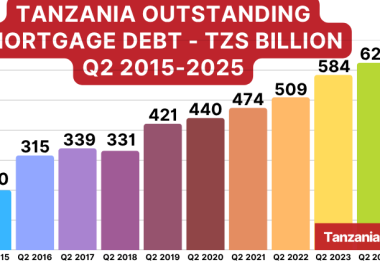
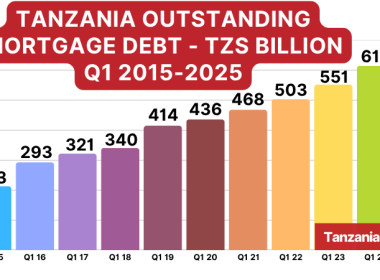
Formal mortgage finance in Tanzania remains shallow at 0.29% of GDP, signaling significant headroom for credit-driven housing expansion.[5]
As of June 2025, 29 banking institutions offer residential Mortgages, with interest rates currently ranging from 13-19%, down sharply from 22-24% in 2010.
The Tanzania Mortgage Refinance Company (TMRC), established in 2020 under the World Bank Housing Finance Project, now counts 21 shareholders and provides long-term liquidity to mortgage lenders.
This refinancing framework is central to government plans to lower borrowing costs and expand affordable housing finance.
Commercial Properties
Occupancy rates for Properties in Tanzania's major cities exceed 80%, reflecting strong demand from corporates, government, and SMEs.[6]
Dodoma, the capital, posts the highest rental prices nationwide following the 2018 government relocation, with sustained demand for office space, retail, and serviced apartments.
Dar es Salaam continues to dominate prime Commercial Properties demand in banking, logistics, and embassy districts, while Arusha and Zanzibar lead hospitality-linked commercial assets.
Policies
The National Land Policy (1995, revised 2023) provides the overarching framework for land tenure, categorizing territory into village, general, and reserve land, while protecting customary ownership rights.
The National Human Settlements Development Policy (2000) promotes urban densification, the provision of serviced land, and shelter for low-income households.[8]
These frameworks are supported by the Land Act 1999, the Village Land Act 1999, the Land Use Planning Act 2007, and the Land Registration Act 2009, which together govern acquisition, registration, and planning.
In 2023, the government removed taxes on low-cost housing priced below TZS 50 million (USD 19,000) and is considering extending the threshold to TZS 100 million to stimulate affordable supply.[9]
A comprehensive Real Estate Act is being finalized and will create a Real Estate Regulatory Authority to professionalize the sector and address the annual deficit of 390,981 houses.[7]
Investment Opportunities
Affordable housing in Dar es Salaam's prime areas—Upanga, Oyster Bay, Masaki, and Mikocheni—offers a direct route to capture the 3 million unit deficit, with Public-Private Partnership (PPP) structures actively supported under Vision 2050.
The informal housing segment represents a major frontier, given that 80% of Tanzanian tenant households share accommodation. Investments in infrastructure upgrades, sewerage networks, and small-scale landlord support can unlock significant value.
Commercial real estate in Dodoma offers attractive yields driven by the highest rental prices in the country following the 2018 government relocation, with continued demand for Grade A office space and retail.
Construction input supply—iron, steel, and cement—is a parallel opportunity tied to emerging industrial nodes including the Lindi LNG corridor and the broader capital-city build-out.
Mortgage market expansion remains a strategic opening, with formal mortgage finance still at just 0.29% of GDP. Investors and lenders can deepen the market through refinancing facilities, mortgage-backed securities, and multilateral-supported partnerships.
Last Update: May 2026
References
- https://www.bot.go.tz/Publications/Regular/Annual%20Report/en/2026022607584561.pdf (Guide reference #1)
- https://data.worldbank.org/indicator/NY.GDP.MKTP.CD?locations=TZ (Guide reference #2)
- https://unctad.org/system/files/official-document/wir2025_en.pdf (Guide reference #5)
- https://www.tiseza.go.tz/uploads/documents/en-1745479851-TIC%202024%20Investment%20FactSheet.pdf (Guide reference #6)
- https://investmentpolicy.unctad.org/international-investment-agreements/countries/222/tanzania-united-republic-of (Guide reference #7)
- https://www.nbs.go.tz/uploads/statistics/documents/en-1767868197-CPI%20Summary_122025.xls (Guide reference #10)
- https://www.nbs.go.tz/uploads/statistics/documents/en-1767868348-Inflation%20Rates%20for%20%20Neighboring%20Countries_122025.pdf (Guide reference #11)
- https://www.bot.go.tz/Publications/Regular/Monthly%20Economic%20Review/en/2026020312553210.pdf (Guide reference #12)
- https://data.worldbank.org/indicator/NY.GNP.PCAP.CD?locations=TZ (Guide reference #13)
Want to know more about Real Estate in Tanzania? Our free overview of the Tanzania Business and Investment Guide 2026 covers Real Estate, plus key sectors and investment opportunities. The complete 141-page edition includes policies, taxation, key regulations, full macroeconomic data, and sources, and is also available at no cost upon completion of a short form.
Download Free OverviewGet the Full Edition for Free