

The Bank of Tanzania (BOT) released its Monthly Economic Review-November 2023 which covers key macroeconomic indicators for the year ending October 2023.
External Sector Performance
The deficit in the current account balance remained large, but narrowed to USD 3,265.5 million in the year ending October 2023, compared with USD 4,990.1 million in the preceding year.
The outturn was on account of increased seasonal earnings from tourism activities and traditional exports.

Foreign Exchange Reserves
On foreign exchange reserves, the stock was USD 4,615 million compared with USD 4,637.2 million at the end of October 2022.
Despite the decrease, reserves were adequate to cover about 4.0 months of projected imports of goods and services.
Exports
The export of goods and services improved, rising by 15.5% to USD 13,544.3 million in the year ending October 2023 from the level recorded in the preceding year.
The performance was largely contributed by non-traditional exports mainly manufactured goods, minerals-mainly gold, and horticultural products.
Non-traditional Goods and Mineral Exports
Export of non-traditional goods grew by 5.5% with the value of gold exports rising to USD 2,987.7 million up from USD 2,813.9 million in the year ending October 2023, on account of both volume and price effects.

On a monthly basis, non-traditional exports fell to USD 532.2 million from USD 552 million.
Traditional Exports
Export of traditional goods edged up to USD 910.3 million from USD 742.7 million (+22.5%), largely driven by exports of coffee and tobacco.
On a monthly basis, export of traditional goods almost doubled to USD 120.9 million higher than USD 64.5 million recorded in a similar month in 2022.
Service and Tourism Receipts
Service receipts increased to USD 5,838.8 million in the year ending October 2023 from USD 4,555.1 million in the corresponding period in 2022, driven by travel (tourism) and transportation receipts.
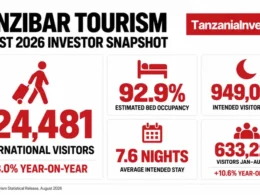
The surge in travel receipts reflects the tourism sector rebound, as tourist arrivals rose to 1,750,557, a record high, from 1,381,881 in the year to October 2022.
On a monthly basis, service receipts were USD 550 million compared with USD 460.4 million in October 2022.
Want to know more about Tourism in Tanzania? Our free overview of the Tanzania Business and Investment Guide 2026 covers Tourism, plus key sectors and investment opportunities. The complete 141-page edition includes policies, taxation, key regulations, full macroeconomic data, and sources, and is also available at no cost upon completion of a short form.
Download Free OverviewGet the Full Edition for Free