


The Bank of Tanzania (BOT) released its Monthly Economic Review-August 2023 which covers key macroeconomic indicators for the year ending July 2023.
External Sector Performance
The external sector of the economy continues to experience the adverse effects of the global shocks: lingering effects of the COVID-19 pandemic, supply-chain disruption caused by the war in Ukraine, climate change effect, and monetary policy tightening through interest rate hikes in advanced economies.
The shocks have led to the widening of the current account deficit following a significant increase in import bills. In the year ending July 2023, the current account deficit widened to USD 4,441 million from a deficit of USD 3,770.7 million in the year ending July 2022.

Nonetheless, the current account position is expected to improve owing to the downward trend of commodity prices in the world market observed since December last year, the lessening of aggressiveness of monetary policy tightening in advanced economies in recent months, and measures adopted in the country to address the imbalance in the current account.
In addition, seasonal earnings from tourism activities and the export of traditional crops are expected to improve the current account position.
Foreign Exchange Reserves
Foreign exchange reserves remained adequate, mainly driven by external loans and grants received by the Government, as foreign exchange inflows from exports were fully absorbed by rising import bills.
The reserves amounted to USD 5,246.7 million at the end of July 2023, slightly below the level reached at the end of July 2022, on account of sales in the interbank foreign exchange market to support the importation of goods and services.
The reserves were sufficient to cover about 4.7 months of projected imports, which were consistent with the country and EAC benchmarks of at least 4 and 4.5 months, respectively.

Exports
Goods and services worth USD 12,991.9 million were exported during the year ending July 2023, 6.33% higher than USD 12,218.2 million in the corresponding period in 2022, driven by services receipts driven by tourism, and non-traditional goods exports, in particular minerals.
Service and Tourism Receipts
Services receipts increased to USD 5,495.2 million in the year to July 2023 from USD 4,125 million in the year ending July 2022, driven by travel (tourism) and transportation receipts.
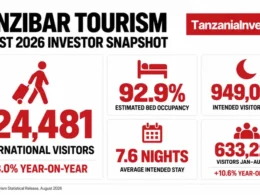
The increase in travel receipts reflects the recovery of the tourism sector, as tourist arrivals rose by 37.2% to 1,658,043 during the year—the highest level ever recorded.
On a monthly basis, service receipts were USD 579.1 million in July 2023, compared with USD 481.9 million in July 2022.
Tanzania Service & Tourism Receipts Year End July 2023 (USD Million)

Non-traditional Goods and Mineral Exports
Exports of non-traditional goods recorded a growth of 6.1%, largely on account of minerals, particularly gold, coal, and diamonds, and manufactured goods.
Coal exports increased by 227.8% to USD 220.7 million in the year to July 2023 from USD 67.3 million a year earlier, owing to growing demand in the wake of supply shortages, following the war in Ukraine.
Exports of diamonds increased by 60.27% to USD 46.8 million from USD 29.2 million in the year ending July 2022 due to price effect.
As for gold exports, the rise was largely due to the volume effect.
Manufactured goods exports also recorded notable growth, largely steered by fertilizers, cement, and glassware.
Traditional Exports
Traditional goods exports also increased to USD 782.6 million from USD 750.6 million, with all traditional goods recording increases except cloves and cashew nuts.
On a monthly basis, traditional goods worth USD 66.5 million were exported in July 2023 compared with USD 36.2 million in a similar month in 2022, while non-traditional exports increased to USD 634.6 million from USD 546.6 million.
Want to know more about Tourism in Tanzania? Our free overview of the Tanzania Business and Investment Guide 2026 covers Tourism, plus key sectors and investment opportunities. The complete 141-page edition includes policies, taxation, key regulations, full macroeconomic data, and sources, and is also available at no cost upon completion of a short form.
Download Free OverviewGet the Full Edition for Free