
Tanzania’s Ministry of Minerals has tabled a TZS 174.98 billion (approximately USD 70 million) budget for the financial year 2026/27, with a revenue collection target of TZS 1.41 trillion (approximately USD 565 million) from a sector whose contribution to GDP has reached 11.9%.
The budget was presented to the National Assembly on 27 April 2026 by the Minister of Minerals, Anthony Mavunde.
Of the total allocation, TZS 71.51 billion (40.87%) is earmarked for development projects, while TZS 103.48 billion (59.13%) is allocated to recurrent expenditure, comprising TZS 27.37 billion for staff salaries and TZS 76.11 billion for other operational charges of the Ministry and its institutions.

Table of Contents
- Tanzania Mining Sector Performance and Investment Position
- Critical and Strategic Minerals Drive
- Value Addition and Industrial Hub at Buzwagi
- Local Content Enforcement Tightened
- Geological Data Coverage and Digitalisation
- Seventh International Mining Investment Conference Announced
- About Tanzania Mining Sector
Tanzania Mining Sector Performance and Investment Position
The mining sector’s contribution to Tanzania’s GDP rose from 9.1% in 2023 to 10.1% in 2024 and reached an average of 11.9% in the first three quarters of 2025 (January–September).
Mineral exports generated USD 5,401.9 million in 2025, up 31.1% from USD 4,119.9 million in 2024, accounting for 52.57% of all goods exported and 63.73% of non-traditional exports.
Gold exports alone rose to USD 4,753.9 million in 2025 from USD 3,419.6 million in 2024, an increase of 39%.
Foreign Direct Investment stock in the mining sector reached USD 9.79 billion in 2024, up from USD 9.15 billion in 2023 and USD 8.64 billion in 2022, making mining the leading sector for FDI in Tanzania.
According to the Fraser Institute 2025 survey, Tanzania ranked 4th in Africa and 34th globally on the Investment Attractiveness Index with a score of 68.04, up from 62.75 in 2024, and 15th globally for mineral resource potential with a score of 75.

Between July 2025 and March 2026, mineral trading worth TZS 4.90 trillion was conducted through mineral markets and buying centres, compared with TZS 2.82 trillion in the corresponding period of 2024/25.
Critical and Strategic Minerals Drive
The Ministry has finalised the Critical and Strategic Minerals Strategy, which will take effect once the official list of critical and strategic minerals is approved.
The strategy targets minerals including lithium, graphite, helium, nickel, cobalt, titanium, copper, aluminium, niobium and rare earth elements, used in modern technologies and clean energy applications.
Between July 2025 and March 2026, the Mining Commission issued 454 licences for critical and strategic minerals, comprising graphite (271), nickel (136), rare earth elements (28), heavy mineral sands (11), lithium (6) and cobalt (2).
On 24 March 2026, the Government signed a development agreement for the Panda Hill niobium project in Mbeya Region, expected to position Tanzania among the world’s top four niobium producers.
The Panda Hill project is expected to create 1,600 direct jobs and 6,336 indirect jobs, generate local procurement worth approximately USD 1.77 billion, and yield approximately TZS 2 trillion to the Government in royalties, taxes, levies and undiluted 16% Government free-carried equity dividends.
Value Addition and Industrial Hub at Buzwagi
The Government has designated the Buzwagi area in Kahama District for the construction of mineral value-addition industries and mining input manufacturing plants, opening a new investment frontier for downstream processing.
The Ministry will continue to promote the construction of processing, smelting, refining and mineral product manufacturing plants, with smelters for copper, nickel, tin and salt under promotion in Dodoma, Shinyanga, Kagera, Mbeya, Lindi and Coast regions.
Six gold refineries are currently operational across Dodoma (1), Shinyanga (1), Geita (2), Dar es Salaam (1) and Mwanza (1), and the Government is supporting refinery owners to obtain London Bullion Market Association (LBMA) accreditation for international market recognition.
Local Content Enforcement Tightened
The Mining Commission will continue to publish the list of goods and services reserved exclusively for 100% Tanzanian-owned companies.
The Minister stated that it is prohibited for any non-Tanzanian to supply goods or provide services that have been declared to be performed exclusively by Tanzanians.
Mining licence holders are required to procure goods and services available locally and to fulfil their Corporate Social Responsibility (CSR) obligations under the revised CSR regulations gazetted on 12 September 2025 and 19 December 2025.
Geological Data Coverage and Digitalisation
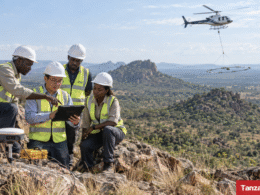
In FY 2026/27, the Geological Survey of Tanzania (GST) will conduct High Resolution Airborne Geophysical Surveys aimed at increasing detailed geophysical data coverage from the current 16% of the country’s territory to 34%, with a long-term target of 50% by 2030 under Mining Vision 2030.
A contractor has been engaged to survey two strategic blocks in southwestern Tanzania covering approximately 176,676.45 square kilometres, equivalent to 18% of the country.
The Ministry will also complete the rollout of the Mineral Sector Management Information System (MSMIS), a digital platform integrated with other Government systems for licence management, monitoring and revenue collection.
Seventh International Mining Investment Conference Announced
The Ministry, in collaboration with the Tanzania Chamber of Mines, will host the 7th International Mining Investment Conference at the Julius Nyerere International Convention Centre in Dar es Salaam from 19 to 21 November 2026.
The event is expected to bring together mining industry experts, executives of exploration and mining companies, service providers, traders and investors from Tanzania and abroad.
About Tanzania Mining Sector
Tanzania is among Africa’s leading mineral producers, with gold accounting for the bulk of mineral export earnings alongside diamonds, tanzanite, coloured gemstones, coal, graphite and a growing portfolio of critical and strategic minerals.
The sector is governed by the Mining Act Cap. 123 and overseen by the Ministry of Minerals through five institutions: the Mining Commission, the Geological Survey of Tanzania (GST), the State Mining Corporation (STAMICO), the Tanzania Gemmological Centre (TGC), and the Tanzania Extractive Industries Transparency Initiative (TEITI).
Tanzania is implementing Mining Vision 2030, structured around five pillars: geoscience information, legal and institutional framework, linkage with other economic sectors, small-scale mining development, and environmental management, in alignment with the country’s long-term development plan Vision 2050 and the Fourth Five-Year National Development Plan (FYDP IV) covering 2026/27 to 2030/31.
In the period July 2025 to March 2026, the Mining Commission issued 8,878 small-scale mining licences, and CRDB Bank signed a Memorandum of Understanding with the Commission to extend financing to artisanal and small-scale miners, with a TZS 50 billion loan facility earmarked for the Songwe Gold Family group in Songwe Region.
Want to know more about Mining in Tanzania? Our free overview of the Tanzania Business and Investment Guide 2026 covers Mining, plus key sectors and investment opportunities. The complete 141-page edition includes policies, taxation, key regulations, full macroeconomic data, and sources, and is also available at no cost upon completion of a short form.
Download Free OverviewGet the Full Edition for Free