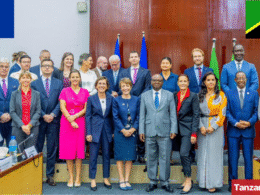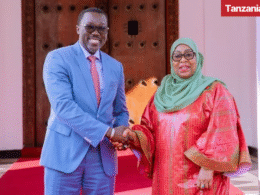




Tanzania hosted the Presidents of Rwanda and Kenya in back-to-back state visits on 3 and 4 May 2026 to deepen cooperation in trade, transport and energy.
The visits delivered an agreement to eliminate all non-tariff barriers between Tanzania and Kenya by May 2026, eight MoUs covering railways and a Dar es Salaam-Mombasa gas pipeline study, and progress on the 80 MW Rusumo Falls Hydroelectric Power Project and the Isaka-Kigali Standard Gauge Railway (SGR) with Rwanda.
Rwanda

President Dr. Samia Suluhu Hassan received Rwandan President Paul Kagame at State House in Dar es Salaam on 3 May 2026 for a one-day working visit.
The two Heads of State held one-on-one talks before leading official bilateral discussions involving delegations from both countries, followed by a joint press conference.
Discussions covered trade and investment, transport and infrastructure, energy, defence and security, immigration, and the coordination of regional and international positions.
President Samia stated that bilateral trade between Tanzania and Rwanda reached TZS 644 billion in 2025.
She added that from 1990 to March 2026, the Tanzania Investment and Special Economic Zone Authority (TISEZA) registered 42 investment projects from Rwanda valued at USD 325.5 million, generating 2,225 jobs for Tanzanians.

The two leaders agreed to accelerate the removal of trade barriers, including non-tariff barriers, to expand commerce and investment and to fully utilise the opportunities of the East African Community common market and the African Continental Free Trade Area (AfCFTA).
On transport and infrastructure, President Samia noted that approximately 70% of Rwanda’s cargo passes through Tanzanian ports, and that Tanzania will continue to provide a conducive environment for handling such cargo, including special services at the Port of Dar es Salaam and the Port of Tanga, as well as dedicated cargo storage areas.
The two Presidents also discussed the development of rail and road infrastructure, including the Isaka-Kigali SGR project aimed at accelerating goods transportation and improving trade efficiency between the two countries.
In the energy sector, the leaders reviewed the Rusumo Falls Hydroelectric Power Project, a joint venture between Tanzania, Rwanda, and Burundi with an installed capacity of 80 MW, alongside power purchase arrangements between the Tanzania Electric Supply Company (TANESCO) and the Rwanda Energy Group (REG) to stimulate economic activity for mutual benefit.
President Kagame thanked President Samia and Tanzanians for the warm reception, describing Tanzania as a key partner for Rwanda, particularly in trade and transport through its ports that connect Rwanda to international markets.
He stated that Tanzania and Rwanda should strengthen their existing strong foundation by advancing strategic cooperation to grow trade, develop joint projects and push forward the development agenda of both countries.
Kagame added that Rwanda will continue working closely with Tanzania to strengthen cooperation within the East African Community, the African Union and other international platforms.
Kenya
The day after Kagame’s departure, on 4 May 2026, Kenyan President William Samoei Ruto arrived in Tanzania for a two-day state visit.
President Ruto held one-on-one talks with President Samia before leading official bilateral discussions between the Tanzanian and Kenyan delegations.
The two Heads of State agreed to eliminate all non-tariff barriers between the two countries, with the removal to be completed within May 2026 and reviewed continuously by the Joint Commission for Cooperation.
President Samia stated that technical teams from both countries will meet to identify and remove all existing barriers within the set timeframe.
The visit was marked by the signing of eight MoUs covering railway development and management, a feasibility study for a natural gas pipeline from Dar es Salaam to Mombasa, legal assistance in criminal matters, agriculture cooperation, mutual recognition of seafarers’ certification, water sector collaboration, partnership between the Zanzibar Bureau of Standards and its Kenyan counterpart, and cooperation between the two countries’ public service training institutions.
The two Heads of State also agreed to jointly develop an SGR line running from Tanga through Kilimanjaro to Taveta in Kenya, with a planned extension to Singida.
President Samia stated that Tanzania and Kenya will deepen cooperation in combating terrorism and human trafficking to strengthen cross-border security and regional peace.
The two leaders reaffirmed cooperation in aviation, agriculture and agribusiness, with Tanzania seeking to expand agricultural exports to Kenya through the National Food Reserve Agency (NFRA), while leveraging Kenya’s expertise in Information and Communication Technology (ICT) to expand opportunities in the digital economy.
According to the Ministry of Foreign Affairs and East African Cooperation, trade between Tanzania and Kenya stood at over USD 720 million in 2024, while Foreign Direct Investment from Kenya into Tanzania between 2020 and 2024 totalled USD 297 million across 109 projects in sectors including banking, manufacturing and telecommunications.
The visit concluded with the Tanzania-Kenya Business Forum, which brought together private and public sector stakeholders from both countries and featured exhibitions on innovation, manufacturing, and trade.
Background
Tanzania, Rwanda and Kenya are member states of the East African Community (EAC), an eight-country regional bloc that operates a common market and customs union.
All three are also signatories to the African Continental Free Trade Area (AfCFTA), which seeks to create the world’s largest single market by number of countries.
Tanzania and Kenya collectively account for about 40% of intra-EAC trade and serve as key gateways for landlocked countries in the region to access global markets through their Indian Ocean ports.
The Port of Dar es Salaam is the principal maritime gateway for landlocked countries in the Great Lakes region, including Rwanda, Burundi, Uganda and the Democratic Republic of Congo.
The Isaka-Kigali Standard Gauge Railway, linking northwestern Tanzania to the Rwandan capital, forms part of the Central Corridor strategy to reduce logistics costs and transit times for regional cargo.
The Rusumo Falls Hydroelectric Power Project, located on the Kagera River along the Tanzania-Rwanda border, is jointly owned by Tanzania, Rwanda and Burundi and supplies electricity to all three countries.
Want to know more about Energy in Tanzania? Our free overview of the Tanzania Business and Investment Guide 2026 covers Energy, plus key sectors and investment opportunities. The complete 141-page edition includes policies, taxation, key regulations, full macroeconomic data, and sources, and is also available at no cost upon completion of a short form.
Download Free OverviewGet the Full Edition for Free