


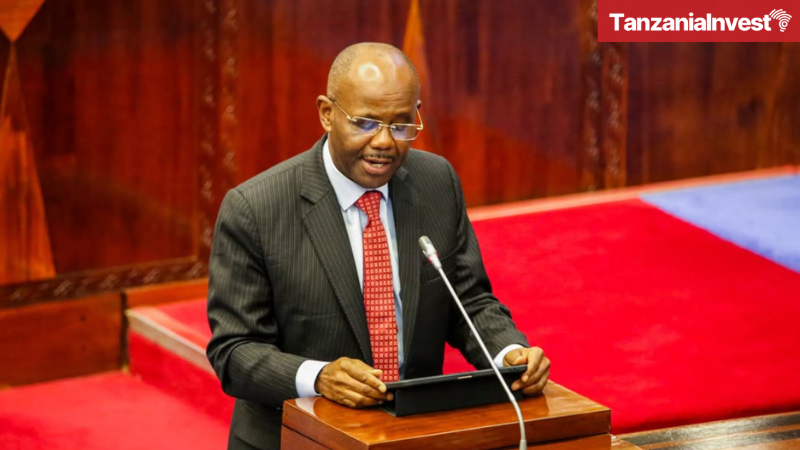
Tanzania’s Ministry of Transport has tabled a TZS 2.87 trillion budget for the 2026/27 financial year, with TZS 2.75 trillion (95.62%) directed to development projects across rail, aviation, ports, and maritime infrastructure.
The budget was presented to the National Assembly by Minister of Transport Prof. Makame Mbarawa on 13 May 2026 in Dodoma, and marks an increase of about 4.6% from the TZS 2.75 trillion approved for 2025/26.
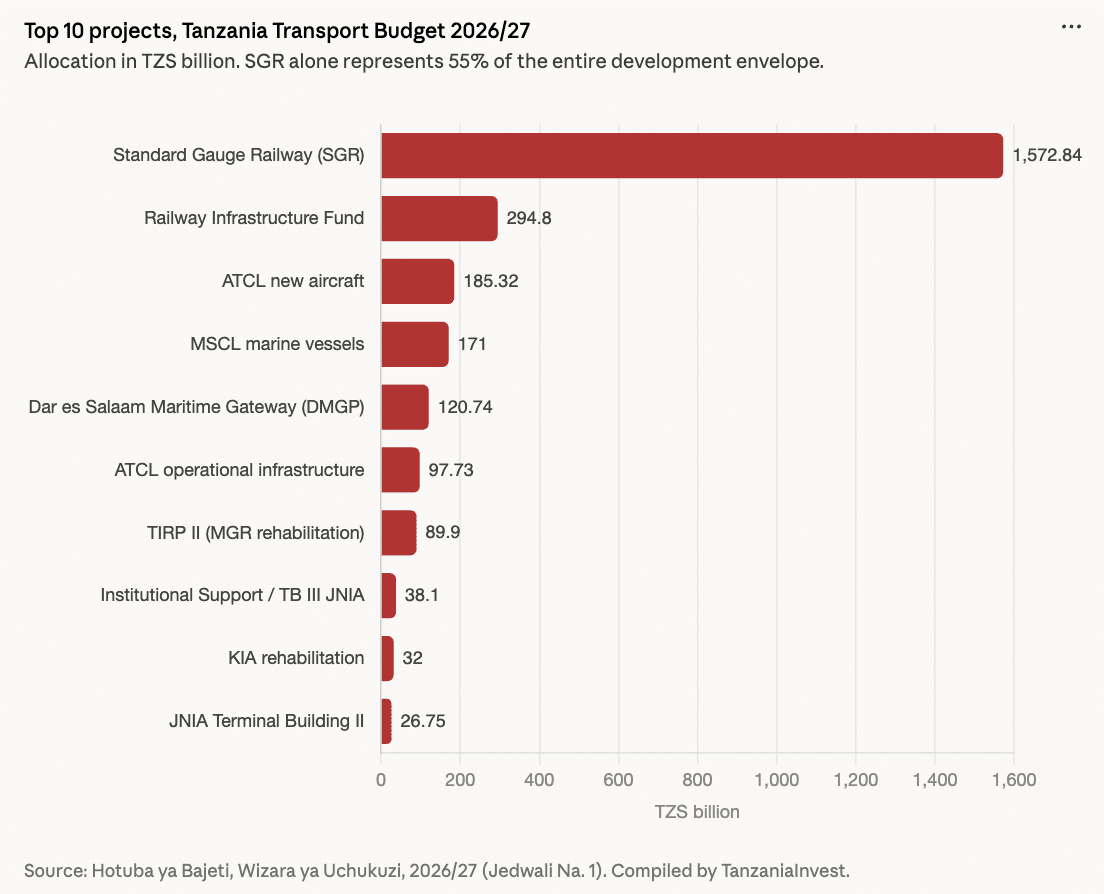
The single largest line item is the Standard Gauge Railway (SGR), which receives TZS 1.51 trillion in domestic financing, equivalent to 55% of the entire development envelope.

Tanzania Transport Budget 2026/27 Structure
The Ministry has requested Parliament to approve TZS 2,872,738,082,000 for Vote 62 for the 2026/27 financial year.
Development expenditure accounts for TZS 2,746,696,846,000 (95.62%), with TZS 2,452,512,444,000 (89.29% of development) financed from domestic sources and TZS 294,184,402,000 (10.71%) from external sources.
Recurrent expenditure accounts for TZS 126,041,236,000 (4.38%), of which TZS 100,135,087,000 covers staff salaries for the Ministry and its institutions and TZS 25,906,149,000 covers other operational charges.
External financing for the 2026/27 budget is drawn from the World Bank (WB) and the European Investment Bank (EIB) for the Dar es Salaam Maritime Gateway Project, the Japan International Cooperation Agency (JICA) for Lake Tanganyika port works, the OPEC Fund for International Development for SGR Lot 7, the World Bank for the Tanzania Intermodal Railway Project (TIRP II), the Government of Korea for the Modernized Railway Training Centre, and the Swedish development finance institution SWEDFUND for the Dar es Salaam Monorail feasibility study.
By March 2026, the Ministry had received TZS 1,374.94 billion, equivalent to 66.75% of the funds due in the period, with recurrent funded at 79.46% and development at 66.04%.

Tanzania Transport Sector Performance to March 2026
The transport sector grew by 4.2% in 2024 and contributed 7.5% to Gross Domestic Product, ranking fifth among the 17 major sectors of the Tanzanian economy.
Cargo handled by the Tanzania Ports Authority (TPA) rose to 29.66 million tonnes between July 2025 and March 2026, a 27.96% increase from 23.18 million tonnes in the same period of 2024/25.
Containers handled rose to 1,005,529 (TEUs) over the same period, up 20.88% from 831,866 TEUs.Cargo handled at the Port of Dar es Salaam alone reached 25.07 million tonnes between July 2025 and March 2026, up 29.83% from 19.31 million tonnes a year earlier.
Cargo destined for neighbouring landlocked countries (Rwanda, Burundi, Uganda, Zambia, Malawi, the Democratic Republic of the Congo, and Zimbabwe) transiting through Tanzanian ports reached 10.93 million tonnes between July 2025 and March 2026, up 32.64% from 8.24 million tonnes a year earlier.
Following the 2023 decision to involve the private sector in operating the Port of Dar es Salaam, average monthly container throughput rose from 61,000 TEUs to 102,000 TEUs (+67.21%), and customs revenue collected by the Tanzania Revenue Authority (TRA) at the port rose from TZS 7.33 trillion in 2020/21 to TZS 11.07 trillion in 2024/25.
Bus passenger volumes using the National Electronic Ticketing System reached 21.34 million by March 2026, up 55.65% from 13.71 million a year earlier.
The Tanzania Ports Authority (TPA) generated TZS 718.99 billion in revenue from passenger and cargo services by March 2026.
The Government commissioned the MV New Mwanza vessel on 23 January 2026, which now operates on Lake Victoria between Mwanza and Bukoba, and laid the foundation stone for the modernization of the Tanzania-Zambia Railway Authority (TAZARA) in Lusaka with Zambia and China on 20 November 2025.A first national pilot training course began at the National Institute of Transport (NIT) on 8 July 2025.
Transport Priorities for 2026/27
The 2026/27 budget supports priorities across the sub-sectors of ports, rail, aviation, maritime transport, weather services and sector training.
The priorities are aligned with the Fourth National Five-Year Development Plan 2026/27-2030/31, the Tanzania Development Vision 2050 and the Government’s strategy to make Tanzania the preferred logistics gateway for Eastern, Central and Southern Africa.
The Ministry will continue to involve the private sector in financing and operating transport infrastructure, including the SGR, Air Tanzania Company Limited (ATCL) fleet expansion, port concessions, and airport development.
Railway Projects 2026/27
The SGR receives TZS 1,511,000,000,000 in domestic financing and TZS 61,838,800,000 from the OPEC Fund (SGR Lot 7 Tranche 2) for ongoing works.
The 2026/27 SGR works include routine maintenance on the operational Dar es Salaam-Makutupora section, the completion of the Morogoro-Makutupora segment, and continuing construction on Makutupora-Tabora, Tabora-Isaka, Mwanza-Isaka, Tabora-Kigoma, and the Uvinza-Musongati extension into Burundi.
The budget also covers procurement of locomotives, wagons, machinery, spare parts and maintenance equipment for the SGR network, along with environmental and social safeguards.
The Tanzania Intermodal Railway Project (TIRP II) receives TZS 89,900,092,000 in external financing from the World Bank for the rehabilitation of the Metre Gauge Railway (MGR) from Dar es Salaam to Tabora and Tabora to Isaka, plus feasibility studies for the Kilosa-Mikumi, Tanga-Arusha and Kilosa-Gulwe-Igandu segments.
The Tanzania-Zambia Railway Authority (TAZARA) modernization receives TZS 12,323,862,000 in domestic financing for rehabilitation works and Strategic Business Unit improvements, alongside the trilateral modernization programme with Zambia and China.
The Railway Infrastructure Fund receives TZS 294,801,622,000 in domestic financing to support general railway infrastructure obligations.
The Modernized Railway Training Centre receives TZS 4,600,100,000 in external financing from the Government of Korea.
The Dar es Salaam Monorail System receives TZS 577,919,000 in external financing from SWEDFUND for a feasibility study on a mass urban transit system for the commercial capital.
Aviation Projects 2026/27
Air Tanzania Company Limited (ATCL) receives TZS 185,322,669,000 in domestic financing for the acquisition of new aircraft, plus TZS 97,727,331,000 in domestic financing for operational infrastructure improvements.
The Kilimanjaro International Airport (KIA) rehabilitation receives TZS 32,000,000,000 in domestic financing for the second phase of major runway works, the installation of approach lighting, perimeter fencing and a new administration and service providers building.
The Julius Nyerere International Airport (JNIA) Modernization and Expansion of Terminal Building II receives TZS 26,747,200,000 in domestic financing for terminal upgrades, approach lighting, a runway end safety area, security and information technology systems and internal security fencing.
The Institutional Support project for the operationalisation of Terminal Building III at JNIA receives TZS 17,000,000,000 in domestic financing, and a separate TZS 7,000,000,000 supports the operationalisation of Msalato International Airport in Dodoma.
The Regional Airports Development project receives TZS 14,382,800,000 in domestic financing for upgrades to airports in Lindi, Moshi, Njombe, Musoma, Shinyanga, Sumbawanga and Singida.
The new Kagera Airport at Kyabajwa in Missenyi district receives TZS 1,900,000,000 in domestic financing to complete detailed design and start construction, with the project intended to serve the Kabanga nickel mine, regional tourism circuits and future rail links to Burundi and Rwanda.
The Mwanza Airport construction receives TZS 6,000,000,000, Arusha Airport TZS 3,075,289,122, Mtwara Airport TZS 3,484,000,000, Bukoba Airport TZS 1,900,000,000 and Serengeti Airport TZS 100,000,000, all in domestic financing.
The Tanzania Airports Authority (TAA) receives TZS 10,000,000,000 in domestic financing for compensation of Project Affected Persons across airport sites, and the Presidential Pavilion at Msalato International Airport receives TZS 1,000,000,000.
The Civil Aviation Centre receives TZS 20,880,000,000 in domestic financing for development works.
The Government will continue procuring contractors for the construction of a second passenger terminal at KIA in partnership with development partners, in response to growing tourism arrivals.
Ports and Maritime Projects 2026/27
The Dar es Salaam Maritime Gateway Project (DMGP) receives TZS 120,739,728,000 in external financing from the World Bank and the European Investment Bank for continued port modernization works.
The 2026/27 DMGP works cover rehabilitation of the stacking area at Berths 1 to 7, installation and distribution of electrical supply at Berths 1 to 7 and the Roll-on Roll-off (RoRo) terminal, enabling works for the construction of Berths 12 to 15, and consultancy services for design and supervision.
The Marine Services Company Limited (MSCL) receives TZS 171,000,000,000 in domestic financing for the procurement and rehabilitation of marine vessels operating on Lake Victoria, Lake Tanganyika and Lake Nyasa.
The Improvement of Lake Tanganyika Ports project receives TZS 16,416,388,000 in external financing from JICA for works at Kigoma Port.
The budget also funds VHF navigation aids at TZS 1,800,000,000 in domestic financing to support maritime safety on Tanzania’s lakes and coast.
The Dar es Salaam Maritime Institute receives TZS 1,097,670,878 in domestic financing for institutional development.
Want to know more about Transport in Tanzania? Our free overview of the Tanzania Business and Investment Guide 2026 covers Transport, plus key sectors and investment opportunities. The complete 141-page edition includes policies, taxation, key regulations, full macroeconomic data, and sources, and is also available at no cost upon completion of a short form.
Download Free OverviewGet the Full Edition for Free