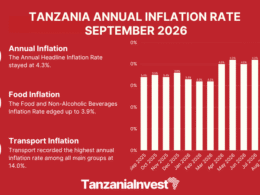




The National Bureau of Statistics of Tanzania (NBS) reveals that the Annual Headline Inflation Rate for the month of October 2022 has increased to 4.9% from 4.8% recorded in September 2022.
The last time the annual rate of inflation in Tanzania was that high was in October 2017 when it reached 5.1%.
The overall index went up from 103.61 recorded in October 2021 to 108.73 in October 2022.

Food and Non-Alcoholic Beverages Inflation Rates
Food and Non-Alcoholic Beverages Inflation Rate for October 2022 has increased to 9.1% from 8.3% recorded in September 2022.
On the other hand, the Annual Inflation Rate for all items without Food and Non-Alcoholic Beverages for October 2022 has decreased to 3.3% from 3.5% recorded in September 2022.
Changes in Tanzania National Consumer Price Indices (NCPI) for October 2022, (2020 = 100)

Tanzania Monthly Inflation Rate – October 2022
The National Consumer Price Index for October 2022 is 108.73 as it was recorded in September 2022.
The stagnation of the index is a result of an increase or decrease in prices for some food items and non-food items between the two periods.
Some of the food and non-food items that have shown an increase in prices include: rice by 4.3%, finger millet grains by 0.6%, maize grains by 2.0%, maize flour by 3.2%, poultry by 0.7%, fresh fish by 0.4%, fresh sardines by 8.9%, dried sardines by 1.0%, fruits by 0.7%, dried beans by 3.9%, soya by 5.1% and dried lentils by 0.9, liquefied hydrocarbons (gas) by 5.1%, firewood by 2.6%, mattresses by 2.3%, laundry soap powdered by 4.0% and food provided by full-service restaurants by 0.7%.

This increase has been counterbalanced by the decrease in prices for some food and non-food items.
Some of the food items and non-food items that have shown a decrease in prices include: wheat grains by 0.6%, cooking oil by 0.9%, groundnuts by 0.6%, vegetables by 1.1%, round potatoes by 5.6%, sweet potatoes by 1.6%, fresh Cassava by 1.2%, cooking bananas by 3.0%, cement by 0.2%, kerosene by 1.1%, charcoal by 0.2%, diesel by 2.5% and petrol by 5.8%.
Want to know more about the Economy in Tanzania? Our free overview of the Tanzania Business and Investment Guide 2026 covers the Economy, plus key sectors and investment opportunities. The complete 141-page edition includes policies, taxation, key regulations, full macroeconomic data, and sources, and is also available at no cost upon completion of a short form.
Download Free OverviewGet the Full Edition for Free