



The Bank of Tanzania (BOT) released its Monthly Economic Review-May 2023 which covers key macroeconomic indicators for the year ending April 2023.
External Sector Performance
Tanzania’s external sector continued to be affected by the cumulative effects of global shocks, particularly the war in Ukraine, which largely impacted global commodity prices.
Reflecting these challenges, the current account deficit widened to USD 5,296.2 million in the year ending April 2023, from USD 2,985.3 million in the year ending April 2022, explained by the high import bill.

Similarly, the balance of payments recorded a deficit of USD 585.4 million, compared to a surplus of USD 679.7 million in the year to April 2022.
Correspondingly, the stock of foreign exchange reserves declined to USD 4,881.2 million at the end of April 2023, from USD 5,461.4 million in the similar period in 2022.
Despite the decline, reserves remained adequate, covering 4.4 months of projected imports of goods and services, in line with the country benchmark of at least 4 months.
Exports
Exports of goods and services amounted to USD 12,440.8 million in the year to April 2023, up from USD 10,607.3 million in the previous year, mostly driven by non-traditional goods exports and services receipts.
Non-traditional Goods and Mineral Exports
Non-traditional goods exports recorded an annual growth of 3.9%, mostly driven by minerals and manufactured goods.

A notable increase was registered in the export of minerals, especially gold. Gold exports increased to USD 2,846.9 million from USD 2,696.1 million, mainly due to volume effects.
The value of manufactured goods increased by 13.6% to USD 1,429.6 million, largely supported by exports of fertilizers and cement.
Other Exports
Exports of traditional goods also increased to USD 765.8 million, from USD 703.7 million. All traditional crop exports increased except cloves and tea—largely on account of price effects.
On a monthly basis, traditional goods worth USD 29.7 million were exported during April 2023, higher than USD 22.3 million in April 2022, while non-traditional exports decreased to USD 436 million from USD 534.2 million.
Service and Tourism Receipts
Services receipts increased to USD 5,166.7 million in the year ending April 2023, from USD 3,590.5 million in the corresponding period in 2022, largely on account of an increase in travel (particularly tourism) and transport receipts.
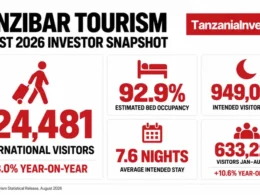
Travel receipts almost doubled to USD 2,826.5 million from USD 1,560.4 as the number of tourist arrivals rose to 1,590,433, higher than pre-pandemic levels, signalling a continued recovery of the tourism sector.
On a monthly basis, services receipts increased to USD 397.8 million, from USD 343.6
million in April 2022.
Want to know more about Tourism in Tanzania? Our free overview of the Tanzania Business and Investment Guide 2026 covers Tourism, plus key sectors and investment opportunities. The complete 141-page edition includes policies, taxation, key regulations, full macroeconomic data, and sources, and is also available at no cost upon completion of a short form.
Download Free OverviewGet the Full Edition for Free