
Capital Markets
Tanzania's Capital Markets reached a total market capitalization of TZS 23,995.45 billion (~USD 9.42 billion) in 2025, +34.30% year-on-year, with the DSE All Share Index up 29.08%, equity turnover surging 190.31%, and unique Central Depository System accounts reaching 740,639.[4]
Tanzania's Capital Markets have grown rapidly since the establishment of the Dar es Salaam Stock Exchange (DSE) in 1996 and the Capital Markets and Securities Authority (CMSA) in 1995.
Total market capitalization reached TZS 23,995.45 billion (~USD 9.42 billion) in 2025, expanding 34.30% year-on-year.[4]
The DSE All Share Index advanced 29.08% year-on-year, equity turnover rose 190.31%, and new Central Depository System (CDS) accounts surged 316.28%, predominantly driven by investors aged 21-30.
Market diversification accelerated with Tanzania's first Exchange Traded Fund (ETF) listed in October 2025, followed by a second EAC-focused ETF launched in January 2026 that was oversubscribed by 540%.
Collective investment schemes recorded the highest growth rate among financial subsectors at 46.1% in 2024[1], with UTT AMIS leading the market with TZS 4.3 trillion in assets under management across six funds.[6]
The DSE is targeting 1 million investors by end of 2026 and 10 million by 2032[8], supported by full integration with Tanzania's largest mobile money platform, which drove a 397% rise in mobile trading registrations and is reshaping retail participation across the country.
Dar es Salaam Stock Exchange
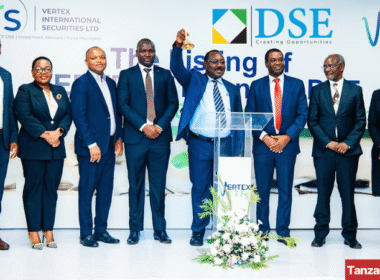
The DSE was established in 1996 as a non-profit entity and became operational in 1998 with the first privatization and listing of a state-owned enterprise.
The CMSA, established in 1995, oversees the regulatory framework for Tanzania's Capital Markets.
The DSE began trading Treasury Bonds in 2002, launched the Enterprise Growth Market (EGM) in 2013, lifted foreign investor restrictions in 2014, introduced a mobile IPO and debt-issuance framework in 2015, demutualized and self-listed in 2016, and required telecoms listings via the 2016 Finance Bill—leading to Vodacom Tanzania's listing in 2017.
The Dar es Salaam Enterprise Acceleration Program (DEAP) was launched in 2019 to prepare SMEs for IPOs, attracting financing from commercial Banks, development banks, Private Equity firms, venture capital, and crowdfunding platforms.
The Hisa Kiganjani mobile trading platform was introduced in 2020, allowing investors to buy, sell, and manage investments directly from phones.
June 2025 trading-rule amendments introduced Volume Weighted Average Price (VWAP) for closing prices, revised price-variation caps, and updated block trade rules to boost liquidity.
The DSE currently has 28 listed companies (two suspended and being delisted)—22 domestic and six cross-listed—alongside Government and corporate bonds.
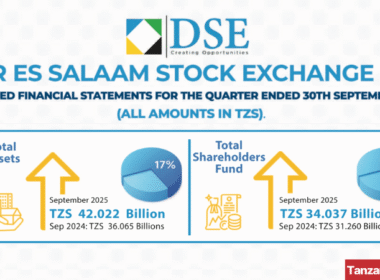
DSE Group revenue reached TZS 17.50 billion in 2025 (+51.67%), profit after tax TZS 6.08 billion (+42.37%), total assets TZS 42.18 billion (+17%), with ROA of 14%, ROE of 17%, EPS of TZS 255, and share price up 203% to TZS 7,150.[6]
Stocks
Total market capitalization reached TZS 23,995.45 billion (~USD 9.42 billion) in 2025, up 34.30% from TZS 17,868.17 billion in 2024.[4]
Domestic market cap stood at TZS 15,559.44 billion (USD 6.11 billion), up 27.08% from TZS 12,243.37 billion in 2024.
The DSE All Share Index (DSEI) advanced 29.08% year-on-year (from 2,139.73 to 2,761.93), the Tanzania Share Index (TSI) rose 24.70% (from 4,618.78 to 5,759.41), and the Banks, Finance and Investments (BI) Index surged 88.46% (from 5,783.87 to 10,900.19), driven by local Banks performance.
Total equity market turnover reached TZS 663.75 billion in 2025 (+190.31%), reflecting a turnover-to-market-cap ratio of 4.26%, with total traded volume of 477.81 million shares (+109.57%).
Mobile trading via Hisa Kiganjani contributed 47.16% of normal-trade turnover (excluding block trades), with 656.38% year-on-year growth.
The CDS recorded 123,547 new accounts in 2025 (+316.28%), 40.33% from investors aged 21-30, bringing total unique CDS accounts to 740,639 (+20.01%).
Bonds
Government securities dominate fixed-income trading on the DSE, while corporate bonds are primarily issued by leading local Banks.
Combined debt and Sukuk securities trading reached TZS 5,860.68 billion in 2025 (+86.08%), with Government securities driving this at TZS 5,848.35 billion (+86.04%) and investor appetite focused on long-dated 15- and 25-year paper.
Corporate and sub-national bonds traded TZS 12.12 billion (+174.43% from TZS 4.41 billion in 2024).
Sukuk certificates traded TZS 214.19 million in 2025—the first Sharia-compliant Sukuk was issued in 2021 raising TZS 2 billion, oversubscribed 36% with TZS 2.72 billion in bids.[5]
The Tanga UWASA 2024 green bond—a 10-year TZS 53.12 billion issuance at 13.5% annual interest, oversubscribed 103% and listed on both the DSE and the Luxembourg Stock Exchange—is Tanzania's first sub-national green bond.
Collective Investment Schemes
Total Net Asset Value (NAV) reached TZS 2,686.0 billion in 2024 (+46.1%)—the highest growth rate among financial subsectors.[1]
The number of approved funds rose from 9 in 2020 to 20 in 2024, while total investors increased 88.8% to 420,682.
UTT Asset Management and Investor Services (UTT AMIS) dominates the market with TZS 4.3 trillion AUM across six funds—Umoja Fund, Jikimu Fund, Watoto Fund, Bond Fund, Wekeza Maisha, and Liquid Fund.[6]
Growth has been driven by expert portfolio management, technological advancement enabling digitalized investor access, and strong underlying-security returns from equities and bonds.
Exchange Traded Funds
Tanzania's first ETF was listed on the DSE in October 2025, tracking a diversified portfolio of actively traded equities on the DSE, broadening investor participation and supporting financial sector growth.
A second ETF launched in January 2026 focuses on large-cap equities listed across the East African Community and was oversubscribed by 540%.
ETFs and Sukuk additions are central to the DSE's diversification strategy to attract both domestic and international investors.
Private Equity and Startups
Private Equity firms, venture capital funds, and crowdfunding platforms are explicit financing channels within the DSE's Enterprise Growth Market (EGM) and DEAP pipeline preparing SMEs and Startups for IPOs.
Tanzania's Startups ecosystem is expanding alongside fintech, agritech, healthtech, and clean-tech segments.
DEAP pilot insights are expected to inform future integration into the EGM segment infrastructure, broadening access to growth capital for high-potential domestic companies.
Cryptocurrencies
9.7% of adult Tanzanians were aware of Cryptocurrencies in 2023, with 1.7% actively investing in them.[2]
The National Cryptocurrency Technical Committee (NTC) conducted a pilot assessment in Dar es Salaam and Zanzibar, analyzing transaction volumes, market activities, and regulatory issues using data from exchanges, blockchain explorers, and crypto wallets.
No specific regulation currently governs Cryptocurrencies in Tanzania, though President Samia Suluhu Hassan acknowledged in June 2021 that blockchain and digital assets represent the future of finance.[3]
The Bank of Tanzania is researching the feasibility of a central bank digital currency (CBDC), with the assessment focused on population readiness, infrastructural requirements, and implications for national payment systems and monetary policy.
Policies
The Capital Markets and Securities Act of 1994 (as amended) and the Companies Act No. 12 of 2002 govern Tanzania's Capital Markets, overseen by the CMSA.
Subsidiary rules and codes address operations, corporate governance, and cross-border listings—with regulations covering licensing, investor protection, transparency, and market conduct.
DSE trading rules were amended in June 2025 to improve market liquidity, transparency, and investor protection, introducing VWAP closing prices, revised price-variation caps, and revised block-trade rules.
A market-aligned Treasury bond coupon rate system was introduced in January 2025, replacing the fixed-rate system to ensure rates reflect prevailing market conditions.
The Financial Sector Development Master Plan 2020/21-2029/30 anchors Capital Markets development under the broader nine-priority framework alongside Banking and Insurance reforms.
The Foreign Investors Regulations (2014 amendment) lifted restrictions on foreign participation in DSE-listed securities, and the 2016 Finance Bill required telecommunications companies to list on the DSE, leading to the Vodacom Tanzania listing in 2017.
No specific Cryptocurrencies regulation is in place—the BOT is actively researching CBDC feasibility, with the National Cryptocurrency Technical Committee piloting market assessment.
Investment Opportunities
Product diversification on the local exchange opens entry points through new market segments and instruments designed to attract domestic and international investors, including State-Owned Enterprise support instruments and sustainability-focused Sukuk.
ETF issuance and asset management show strong momentum — the first Tanzanian ETF launched in October 2025 and a second EAC-focused ETF was 540% oversubscribed, demonstrating clear institutional and retail appetite for diversified passive products.
Sukuk and Sharia-compliant instruments are gaining traction — Tanzania's first Sukuk (2021) was oversubscribed 36%, with a growing pipeline aligned to the Muslim population's demand for ethical instruments.
Green and sustainable bonds offer scalable models — the Tanga UWASA TZS 53.12 billion sub-national green bond (2024) at 13.5% interest set a working framework for water and infrastructure financing.
Private equity, venture capital and crowdfunding channels are increasingly linked to listing pipelines that prepare SMEs for IPO and connect growth capital to high-potential domestic companies.
Digital trading infrastructure is reshaping market access — mobile trading drove 656.38% year-on-year turnover growth and 316.28% new CDS account growth, with mobile-driven turnover reaching 24.3% of total equity trading.[7]
Collective investment schemes — TZS 2.7 trillion in NAV growing 46.1% annually — open space for new fund managers, ESG funds, and innovative liquidity products, while bond market depth supports demand for long-dated 15- and 25-year Government paper, corporate bond underwriting, dealer-broker expansion, and emerging digital-asset and CBDC-related infrastructure plays.
Last Update: May 2026
References
- https://www.bot.go.tz/Publications/Regular/Financial%20Stability/en/2025072310063848.pdf (Guide reference #106)
- https://www.fsdt.or.tz/wp-content/uploads/2023/07/FinScope-Tanzania-2023-Full-Report-Insights-that-Drive-Innovation.pdf (Guide reference #110)
- https://www.pwc.co.tz/press-room/navigating-uncharted-territory.html (Guide reference #111)
- https://www.tanzaniainvest.com/wp-content/uploads/2026/03/Dar-Es-Salaam-Stock-Exchange-Market-Performance-2025.pdf (Guide reference #112)
- https://uttamis.co.tz/ (Guide reference #114)
- https://www.instagram.com/p/DUL1KsnDIF1/?hl=en&img_index=1 (Guide reference #115)
- https://dse.co.tz/storage/securities/DSE/financial_statement/Annual/PZFznv6PcCqY3s7h7hyLGLmHKoxcxu11OXxjL4pf.pdf (Guide reference #122)
- https://dailynews.co.tz/govt-dse-to-expand-capital-market-access (Guide reference #123)
Want to know more about Capital Markets in Tanzania? Our upcoming Capital Markets Guide covers the Dar es Salaam Stock Exchange (DSE), listed companies, bonds, and private equity, plus the regulatory framework for investing in Tanzania’s capital markets.
Learn MoreWant to know more about the Capital Markets in Tanzania? Our free overview of the Tanzania Business and Investment Guide 2026 covers the Capital Markets, plus key sectors and investment opportunities. The complete 141-page edition includes policies, taxation, key regulations, full macroeconomic data, and sources, and is also available at no cost upon completion of a short form.
Download Free OverviewGet the Full Edition for Free