

Banks
List of Banks in Tanzania in 2025
As of January 2025, 45 licensed banks are operating in Tanzania: 34 commercial banks, 3 community banks, 4 microfinance banks, 2 development banks, 1 House Financing Company, and 1 Mortgage Refinancing Company.
| Bank | Type | Title | Name | |
|---|---|---|---|---|
| Commercial Banks: 34 | ||||
| Absa Bank | Commercial Bank | MD/CEO | Obedi Laiser | |
| Access Bank | Commercial Bank | MD | Imani John Bgoya | |
| Akiba Commercial Bank (ACB) | Commercial Bank | MD | Silvest Arumasi | |
| Amana Bank | Commercial Bank | MD | Abubakar Athman Ali | |
| Azania Bank | Commercial Bank | MD | Esther Mang'enya | |
| Bank of Africa (BOA) | Commercial Bank | MD | Esther Cecil Maruma | |
| Bank of Baroda | Commercial Bank | MD | Aditya Narayan Singh | |
| Bank of India | Commercial Bank | MD | Antaryami Sarangi | |
| China Dasheng Bank | Commercial Bank | CEO | Cheng Ji | |
| Citibank | Commercial Bank | MD/CEO | Geofrey Mchangila | |
| CRDB Bank | Commercial Bank | MD/CEO | Abdulmajid Nsekela | |
| DCB Commercial Bank | Commercial Bank | MD | Sabasaba Moshinghi | |
| Diamond Trust Bank (DTB) | Commercial Bank | CEO | Ravneet Chowdhury |
|
| Ecobank | Commercial Bank | MD | Charles Asiedu | |
| Equity Bank | Commercial Bank | MD & CEO | Isabela Maganga | |
| Exim Bank | Commercial Bank | CEO | Jaffari Matundu | |
| Guaranty Trust Bank (GTBank) | Commercial Bank | MD | Odunayo Akinyede | |
| Habib African Bank | Commercial Bank | MD | Shaheen Hassan Rizvi | |
| I&M Bank | Commercial Bank | CEO | Zahid Mustafa | |
| International Commercial Bank (ICB) | Commercial Bank | CEO | Sanjeev Anand | |
| KCB Bank | Commercial Bank | MD | Cosmas Kimario | |
| Letshego Faidika Bank | Commercial Bank | CEO | Baraka Munisi | |
| Maendeleo Bank | Commercial Bank | MD | Lomnyaki Saitabau | |
| Mkombozi Commercial Bank (MKCB) | Commercial Bank | MD | Respige Kimati | |
| Mwalimu Commercial Bank (MCB) | Commercial Bank | CEO | Richard Makungwa | |
| Mwanga Hakika Bank | Commercial Bank | MD | Jagit Singh | |
| National Bank of Commerce (NBC) | Commercial Bank | MD | Theobald Sabi | |
| NCBA | Commercial Bank | MD/CEO | To be appointed | |
| NMB | Commercial Bank | MD/CEO | Ruth Zaipuna | |
| Peoples' Bank of Zanzibar | Commercial Bank | MD | Arafat Haji | |
| Stanbic Bank | Commercial Bank | CEO | Manzi Rwegasira | |
| Standard Chartered Bank | Commercial Bank | CEO | Herman Kasekende | |
| Tanzania Commercial Bank (TCB) | Commercial Bank | CEO | Adam Mihayo | |
| United Bank for Africa (UBA) | Commercial Bank | MD/CEO | Gbenga Makinde | |
| Community Banks: 3 | ||||
| Co-operative Bank of Tanzania (CBT) | Community Bank | MD | Godfrey Joe Ng'ura | |
| Mufindi Community Bank (MuCoBa) | Community Bank | GM | Phlip Raymond | |
| Uchumi Commercial Bank | Community Bank | GM | Samwel Wado | |
| Microfinance Banks: 4 | ||||
| Finca Microfinance Bank | Microfinance Bank | CEO | Edward Talawa | |
| Selcom Microfinance Bank (formerly AccessBank) | Microfinance Bank | CEO | Julius Ruwaichi | |
| VisionFund Tanzania Microfinance Bank | Microfinance Bank | CEO | Chilala Hakooma | |
| Yetu Microfinance Bank (taken over by NMB) | Microfinance Bank | MD | Umaiya Abbas Masoli | |
| Development Banks: 2 | ||||
| TIB Development Bank | Development Bank | MD | Deogratius Kwiyukwa | |
| Tanzania Agricultural Development Bank (TADB) | Development Bank | MD | Frank Nyabundege | |
| House Financing Companies: 1 | ||||
| First Housing Company Tanzania | House Financing Company | CEO | Sasa Chonza | |
| Mortgage Refinancing Company: 1 | ||||
| Tanzania Mortgage Refinance Company (TMRC) | Mortgage Refinancing | CEO | Oscar Mgaya |
Tanzania Banking Sector Total Assets
In 2023, total assets rose by 17.4% compared to 2022 reaching TZS 54,263.0 billion, driven mainly by a rise in deposits.
| Type of Banking Institutions | Dec-19 | Dec-20 | Dec-21 | Dec-22 | Dec-23 |
|---|---|---|---|---|---|
| Commercial Banks | 94.3% | 95.1% | 96.4% | 97.1% | 97.6% |
| Community Banks | 0.5% | 0.6% | 0.7% | 0.4% | 0.1% |
| Microfinance Banks | 0.5% | 0.3% | 0.4% | 0.4% | 0.4% |
| Development Financial Institutions | 4.8% | 3.9% | 2.5% | 2.0% | 1.9% |
| Total Assets (TZS Billion) | 33,067.3 | 34,888.4 | 39,590.1 | 46,228.6 | 54,263.0 |
The top biggest banks in Tanzania by assets in 2023 were:
| No. | Bank Name | Total Assets TZS | Total Assets USD |
|---|---|---|---|
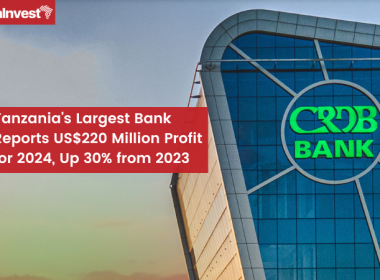
| 1 | CRDB Bank | 13.2 TZS Trillion | 5.6 USD Billion |
| 2 | NMB Bank | 12.2 TZS Trillion | 5.2 USD Billion |
| 3 | National Bank of Commerce (NBC) | 3.6 TZS Trillion | 1.5 USD Billion |
| 4 | Exim Bank | 3.0 TZS Trillion | 1.3 USD Billion |
| 5 | Azania Bank | 2.1 TZS Trillion | 0.9 USD Billion |
| 5 | Standard Chartered Bank | 2.1 TZS Trillion | 0.9 USD Billion |
| 6 | Diamond Trust Bank (DTB) | 1.8 TZS Trillion | 0.8 USD Billion |
| 6 | People’s Bank of Zanzibar (PBZ) | 1.8 TZS Trillion | 0.8 USD Billion |
| 7 | Absa Bank | 1.4 TZS Trillion | 0.6 USD Billion |
| 7 | Stanbic Bank | 1.4 TZS Trillion | 0.6 USD Billion |
| 7 | Tanzania Commercial Bank (TCB) | 1.4 TZS Trillion | 0.6 USD Billion |
| 8 | Citibank | 0.9 TZS Trillion | 0.3 USD Billion |
The top 10 biggest banks in Tanzania by assets in 2022 were:
1. CRDB with TZS 11.6 trillion (USD 4.9 billion)
2. NMB with TZS TZS 10.2 trillion (USD 4.2 billion)
3. NBC with TZS 2.8 trillion (USD 1.2 billion)
4. Exim with TZS 2.3 trillion (USD 1 billion)
5. DTB with TZS 1.6 trillion (USD 680 million)
6. PBZ with TZS 1.4 trillion (USD 590 million)
7. Stanbic with TZS 1.3 trillion (USD 560 million)
8. StanChart with TZS 1.3 trillion (USD 560 million)
9. Citi Bank with TZS 1.3 trillion (USD 560 million)
10. Absa with TZS TZS 1.1 trillion (USD 460 million)
11. TCB with TZS 1.1 trillion (2021) (USD 460 million)
Tanzania Banking Network
In 2022, the total number of bank branches and ATMs fell to 987 from 990 in 2021. Large banks accounted for 55.2% of the branch network. Urban centers accounted for 51.6% of total branches.
In 2013, the Central Bank of Tanzania (BOT) introduced comprehensive agent banking guidelines that permit licensed banks and financial institutions to appoint retail agents for their banking services.
This provides a mechanism through which banks can profitably extend their services to previously unbanked lower-income individuals.
The agent banking business has grown regularly since then in the number of agents, number of transactions, and value of deposit and withdrawal transactions. In 2022, the total number of bank agents increased by 53% to 75,238 from 48,923 in 2021.
Deposits through agents increased by 71.1% to TZS 61,915.9 billion. The agent banking business is dominated by large banks which accounted for 59.7%. Urban centers accounted for 56.5% of total operating bank agents.
Last Update: 10th June 2025
Want to know more about Banks in Tanzania? Our free overview of the Tanzania Business and Investment Guide 2026 covers Banks, plus key sectors and investment opportunities. The complete 141-page edition includes policies, taxation, key regulations, full macroeconomic data, and sources, and is also available at no cost upon completion of a short form.
Download Free OverviewGet the Full Edition for Free