
Construction
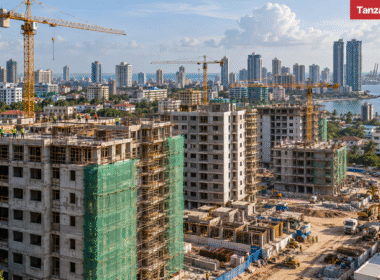
Tanzania's construction sector is anchored by a Real Estate industry valued at TZS 5.4 trillion growing at 4.3% and a Water sector valued at TZS 0.95 trillion growing at 4.1%, supported by an ambitious pipeline of FYDP IV Flagship Projects and infrastructure investments aligned with Vision 2050.
The construction pipeline is led by FYDP IV Flagship Projects including the Bagamoyo Eco-Maritime City and Intermodal Transport, the Liganga-Mchuchuma Integrated Iron and Steel Complex, the Lindi LNG Project, the Dodoma Mineral and Technological Valley, the National Irrigation and Agro-Industrial Transformation Program, the Great Lakes Smart Industrial and Blue Economy Mega Hub, and the Tanzania Urban Growth Nexus (TUGNe 2050).
These Flagship Projects are reinforced by ongoing investments in energy, water, Ports, Roads, the SGR (Standard Gauge Railway), and ICT backbone systems, ensuring spatial coordination and sustained industrialization.
According to the Ministry of Works Budget 2025/2026[3], other major infrastructure projects include the Msalato International Airport in Dodoma, the Dar es Salaam Bus Rapid Transit (BRT) Program Phases III/IV/V, the Dar-Chalinze-Morogoro-Dodoma Expressway of 531.8 km, the Dodoma City Outer Dual Carriageway Ring Road of 112.3 km, and the Pangani Bridge.
Tanzania has been selected to host AFCON 2027, prompting the construction and rehabilitation of stadiums—including the new Samia Suluhu Hassan Stadium in Arusha and a new stadium in Dodoma—with financing identified as a priority area in the 2025/26 national budget.
Real Estate
The Real Estate sector reached TZS 5.4 trillion in 2024, contributing 2.5% to GDP in the first nine months of 2025, with growth of 4.3% matching 2024[2].
Demand is driven by Tanzania's 70 million population (62.7 million per the 2022 Census, growing 3.2% annually and projected to reach 123.4 million by 2044[1]), with 65.1% rural and 34.9% urban residence (up from 23.1% in 2002) and Dar es Salaam at 100% urban.
The Housing deficit stands at 3,000,000 units with annual demand of +200,000 units[5], and Tanzania will require 26,840,909 housing units by 2050[6].
Mortgages remain underdeveloped, with formal Mortgages finance at 0.29% of GDP and approximately 99% of houses built out-of-pocket over 5-10 years.
Interest rates have declined to 13-19% today from 22-24% in 2010[7], with 29 banking institutions offering residential mortgages as of June 2025, while consumer loans up to TZS 150 million (USD 58,000) for 7 years compete directly with mortgage products.
The 2022 Tanzania Buildings Census recorded 14,348,372 buildings (13,907,951 Mainland plus 440,421 Zanzibar)[8], with Dodoma, Mwanza and Dar es Salaam as leading hubs.
94.4% of buildings are single-story and 91.4% residential, with individual home-builders supplying 70% of housing and the public sector contributing through the NHC (National Housing Corporation) and national pension funds.
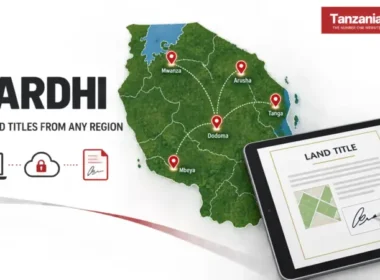
Land tenure shows 67.1% of buildings on unsurveyed land, 22.6% surveyed and 6.8% regularized, with urban land 45.6% surveyed versus rural at 12.8%, and all land vested in the President as trustee.
Main hubs include Dar es Salaam as commercial capital with prime areas Upanga, Oyster Bay, Masaki and Mikocheni where stand-alone houses cost TZS 6-12 million[9], Dodoma as the political capital and real estate hot spot since the 2018 government relocation, Mwanza as Lake Zone business hub, Arusha as safari tourism hub, and Zanzibar as beach tourism hub.
Commercial Properties achieve occupancy above 80% in major cities, with Dodoma, Mbeya and Mwanza at 100% occupancy[10], and Dodoma commanding the highest rental prices following the government relocation.
Water Sector
The Water sector reached TZS 0.95 trillion, contributing 0.5% to GDP in 2024 and the first nine months of 2025, with growth of 4.1%[2].
Tanzania has 126,000 billion cubic meters of annual renewable water resources and 40 billion cubic meters of storage across 651 registered dams.
Surface water provides 40% of abstracted water, lakes 19% and dams 8%, with rural access at 83% in 2024 and urban access at 91.6%[14].
Nationally, 24.9% of buildings have water services (urban 47.6%, rural 15.1%), with Dar es Salaam at 62.9%, Kilimanjaro at 46.8% and Arusha at 36.6% as top regions.
Water demand reached 858.05 million cubic meters in 2023/2024 (+4.6%)[15], production capacity expanded 7% to 735.7 million cubic meters, and water connections rose to 1,669,298 (+9%).
Sewerage connections reached 59,691 (+4.9%), while 59.6% of households use pit latrines, 39.7% use septic tanks and 0.8% have no sanitation, with Water Supply and Sanitation Authorities (WSSAs) expanding services in Dar es Salaam, Mbeya, Arusha, Tanga, Dodoma and Mwanza.
Policies
Sector governance is shared across the Ministry of Works, Ministry of Transport, Ministry of Communication and Information Technology and Ministry of Water.
The Tanzania Development Vision 2050 (TDV 2050) targets universal access to safe and clean water and sanitation, affordable clean energy and decent Housing, while FYDP IV serves as the first medium-term plan implementing Vision 2050 and drives the flagship projects.
The National Public-Private Partnership (PPP) Policy[4] provides the framework for attracting private capital to infrastructure under DBFOM and BOT models—examples include the Kilimanjaro International Airport expansion under management contract and the Nyerere Kigamboni Bridge in Dar es Salaam under joint venture—with 2023 PPP policy amendments creating a more enabling environment.
The National Land Policy of 1995 (revised 2023) provides a comprehensive framework for land tenure, categorizing territory into village, general and reserve, protecting customary ownership while encouraging private sector and foreign investment.
The National Human Settlements Development Policy of 2000[12] promotes urban densification, serviced land and shelter for the poor, supported by the Land Act 1999 (Cap 113), the Village Land Act 1999 (Cap 114), the Land Use Planning Act 2007 and the Land Registration Act 2009.
The Tanzania Mortgage Refinance Company (TMRC), established in 2020 under the World Bank Housing Finance Project, had 21 shareholders as of 31 December 2025.
The 2023 tax removal on low-cost housing below TZS 50 million (USD 19,000) is under consideration for extension to TZS 100 million[13], and a comprehensive Real Estate Act is being finalized with a proposed Real Estate Regulatory Authority to address an annual deficit of 390,981 houses[11].
The National Water Policy (NAWAPO) 2002 version 2025[14] guides water resources management, water quality, supply, sanitation and hygiene, with the Water Sector Development Program WSDP III running from July 2022[16] for integrated water resources management.
FYDP IV water targets include 87.9% rural and 97.2% urban clean water access, 100% piped or protected water in regional centers and Dar es Salaam, and 60% of Dar es Salaam connected to public Sewerage.
Investment Opportunities
Affordable housing across Dar es Salaam's prime corridors of Upanga, Oyster Bay, Masaki and Mikocheni offers significant scope to address the 3,000,000 unit deficit. Informal housing — where 80% of Tanzanian tenant households share accommodation — opens parallel entry points for infrastructure upgrades and small-scale landlord support.
Flagship projects including Bagamoyo, Lindi LNG, iron and steel complexes and the SGR network generate sustained demand for contractors and developers. Adjacent pipelines in roads, expressway corridors, ring road systems, ports and airports broaden the addressable market.
AFCON 2027 is driving stadium construction in Arusha and Dodoma, with spillover demand across accommodation, transportation and food and beverage supply.
Water green revenue bonds have emerged as a proven financing template, after a 10-year TZS 53.12 billion green bond in 2024 priced at 13.5% annual interest was oversubscribed by 103% and dual-listed locally and on the Luxembourg Stock Exchange. The structure is replicable for further water infrastructure financing across regional utilities.
Commercial property in Dodoma delivers some of the highest rental yields in the country following the 2018 capital relocation, with persistent demand for office space supply.
The wider construction value chain — building materials supply, civil engineering services, project management and urban planning aligned with TUGNe 2050 — provides cross-sector opportunities supported by the BRT (DART) program in Dar es Salaam and an active PPP pipeline.
Last Update: May 2026
References
- https://www.nbs.go.tz/uploads/statistics/documents/sw-1738321655-01.%20URT_Demographic%20and%20Socioeconomic%20Profile.pdf (Guide reference #8)
- https://www.bot.go.tz/Publications/Regular/Quarterly%20Economic%20Bulletin/en/2026020820330341.pdf (Guide reference #66)
- https://www.mow.go.tz/uploads/documents/en-1746433881-HOTUBA%20YA%20BAJETI%202025.pdf (Guide reference #74)
- https://ppp.worldbank.org/sites/default/files/2024-07/Tanzania_PPP%20Policy.pdf (Guide reference #75)
- https://www.nhc.co.tz/img/NHC%20FS%20June%202024%20Audited.pdf (Guide reference #76)
- https://www.tanzaniainvest.com/construction/realestate/housing-demand-2050 (Guide reference #77)
- https://www.tmrc.co.tz/resources/view/tanzania-mortgage-market-update-30-june-2025 (Guide reference #78)
- https://www.nbs.go.tz/uploads/statistics/documents/en-1719124055-04.%20Building_Census2022_English08April.pdf (Guide reference #79)
- https://housingfinanceafrica.org/wp-content/uploads/2025/03/TANZANIA.pdf (Guide reference #80)
- https://www.bot.go.tz/Publications/Regular/Financial%20Stability/sw/2025072310063848.pdf (Guide reference #81)
- https://www.lands.go.tz/uploads/documents/sw-1742289453-Signed%20Sera%20ya%20Taifa%20ya%20Ardhi.pdf (Guide reference #82)
- https://faolex.fao.org/docs/pdf/tan205478.pdf (Guide reference #83)
- https://www.thecitizen.co.tz/tanzania/news/national/government-mulls-extending-vat-exemption-to-houses-worth-sh100-million-5044400 (Guide reference #84)
- https://www.maji.go.tz/uploads/publications/sw1742701826-NATIONAL%20WATER%20POLICY.pdf (Guide reference #85)
- https://www.ewura.go.tz/uploads/documents/en-1743160797-Water%20Utilities%20Performance%20Review%20Report%202023-24%20Final.pdf (Guide reference #86)
- https://www.maji.go.tz/uploads/publications/en1742183712-WATER_SECTOR_STATUS_REPORT_2024.pdf (Guide reference #87)
Want to know more about Construction in Tanzania? Our free overview of the Tanzania Business and Investment Guide 2026 covers Construction, plus key sectors and investment opportunities. The complete 141-page edition includes policies, taxation, key regulations, full macroeconomic data, and sources, and is also available at no cost upon completion of a short form.
Download Free OverviewGet the Full Edition for Free